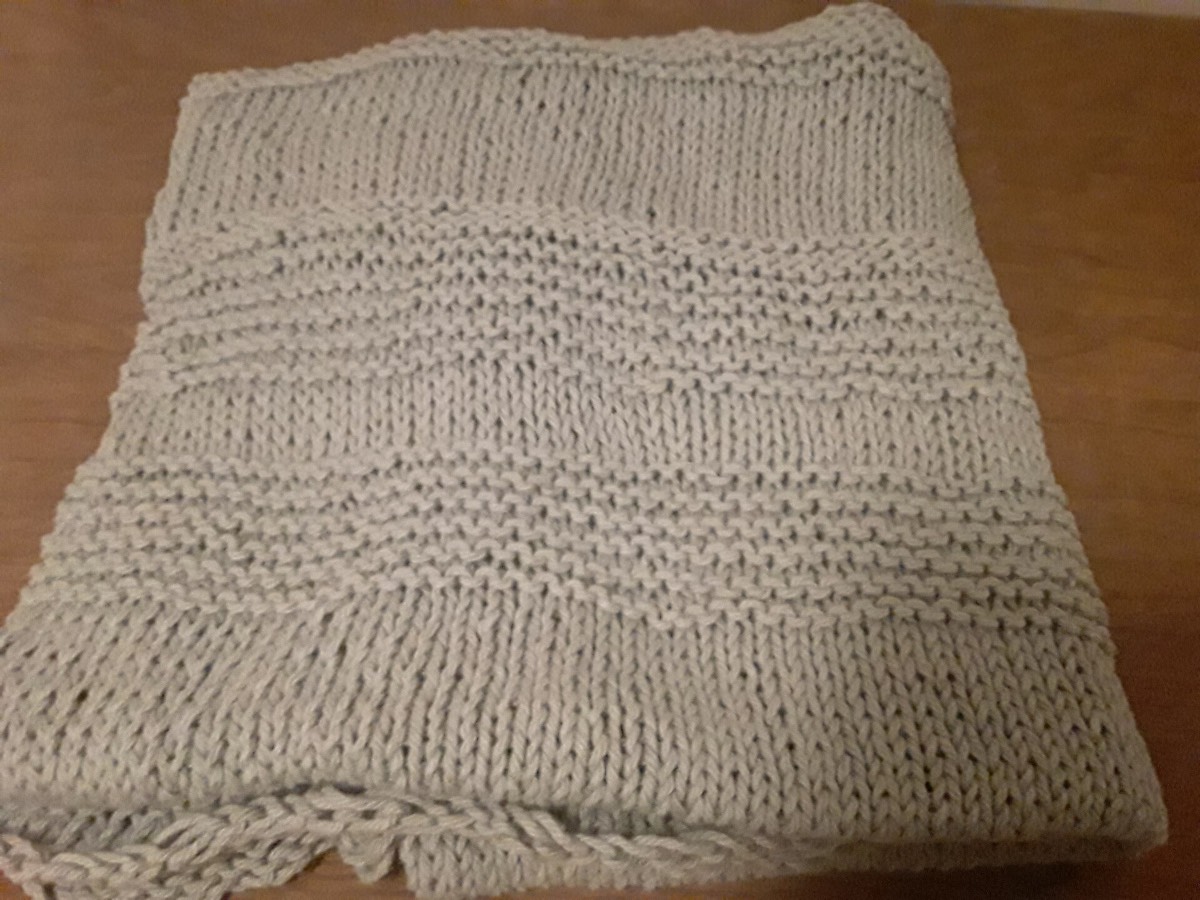

A blanket is the easiest large project to estimate because it is almost pure area. There is no sleeve shaping, no armhole and usually no fitted ease. Measure a swatch, decide the finished size, and multiply.
The estimate still needs a buffer for the border, the cast-on and bind-off, seaming if the blanket is made in strips, and the usual dye-lot risk.
Common blanket sizes
These are common starting points, not standards. Measure the bed or the person if the blanket has to fit something specific.
| Use | Approximate size |
|---|---|
| Stroller / crib | 90 × 110 cm |
| Throw | 120 × 150 cm |
| Twin bed | 150 × 200 cm |
| Queen bed | 200 × 220 cm |
The swatch-weight method
- Knit a swatch at least 15 cm square in the blanket's stitch pattern.
- Wash and dry it the way you will wash the blanket.
- Measure its area in square centimetres and weigh it in grams.
- Divide weight by area to get grams per square centimetre.
- Multiply by the finished blanket area.
- Add the border, then a 10–15% buffer.
A worked example
A throw measures 120 × 150 cm, so its area is 18,000 cm².
A 15 × 15 cm swatch is 225 cm² and weighs 12 g. That is 12 ÷ 225 = 0.0533 g per cm².
18,000 × 0.0533 = 960 g. Add 15% for the border, the cast-on and bind-off, and matching the pattern: about 1,104 g.
At 100 g per skein, buy 12. At 50 g per skein, buy 23. Check the metres per skein as well: 12 skeins at 200 m each give 2,400 m, while 12 at 120 m each give 1,440 m. The substitution calculator can convert the length once you know the put-up.
The border is part of the blanket
Borders and edgings are often worked after the main body, and they can consume a surprising amount of yarn. A wide border on a large blanket can add 10–20% to the total. If the pattern gives a border, estimate its area separately or use the upper end of the buffer.
Blankets made in strips add seaming yarn and a little extra for matching the pattern at the joins. Add 5–10% if you are seaming rather than working in one piece.
Stitch pattern changes the number
Stockinette is the baseline. Cables, colourwork, textured stitches and loose lace all change the grams per square centimetre. A cabled blanket can use noticeably more yarn than a stockinette blanket of the same size. Swatch the dominant pattern; do not substitute a stockinette swatch and assume the difference is small.
Buffer and dye lots
Buy at least 10% more than the calculation suggests, and 15% for a new-to-you fibre or a complex pattern. Buy all the skeins at once, in one dye lot. A large blanket is exactly the kind of project where a late extra skein in a different lot becomes a visible stripe.
Leftover yarn is useful for the border, repairs or a matching cushion. It is not wasted.
If the blanket is already started
You can estimate the remaining yarn from the finished part. Weigh the blanket, measure the area worked so far, and divide weight by area to get the same grams-per-square-centimetre figure. Multiply by the remaining area. This is useful when you are using stash yarn and cannot buy another dye lot.
If the blanket is made in strips, weigh one finished strip and multiply by the number of strips, then add the joining and border allowance.
Limits
The method assumes a rectangular blanket and a swatch that represents the finished fabric. Ripples, circles, hexagons and very open lace need a different approach: estimate from the pattern's own yardage, or weigh a small finished motif and multiply by the number of motifs.