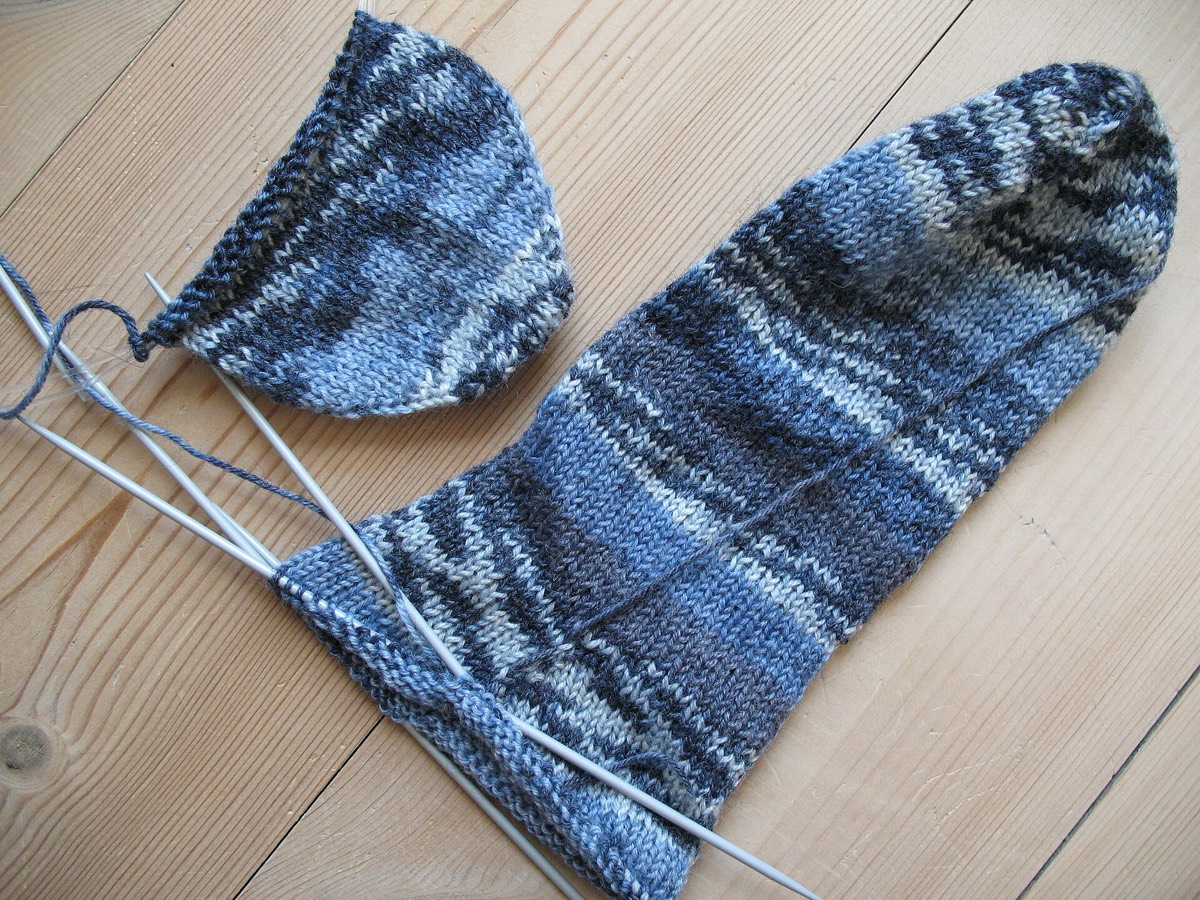

A pair of socks is small, but the yardage is more variable than it looks. A short ankle sock and a knee-high sock use very different amounts of yarn, and two knitters at different gauges can disagree by a whole skein.
The reliable method is the same as for a sweater or a blanket: estimate the fabric area, weigh a swatch, and add a buffer. Socks add one wrinkle — negative ease — because the finished sock is deliberately smaller than the foot.
What changes the number
- Foot length and circumference. A larger foot needs more fabric in both directions.
- Leg length. Ankle socks, crew socks and knee-highs are different quantities.
- Negative ease. The sock should stretch to fit; the finished circumference is smaller than the foot.
- Gauge. A tighter gauge packs more stitches and more yarn into the same area.
- Heel and toe. Short-row heels, flap-and-gusset heels and afterthought heels use different amounts of yarn.
- Yarn put-up. Sock yarns often come in 50 g or 100 g skeins with very different lengths.
The swatch-weight method
- Knit a swatch in the sock's stitch pattern — usually stockinette or a ribbed leg.
- Wash and dry it the way you will wash the socks.
- Measure its area and weigh it.
- Estimate the finished sock's surface area: circumference × (foot length + leg length).
- Multiply by two for the pair, add 20% for heel and toe shaping, then add a 10–15% buffer.
A worked example
Foot length 24 cm, foot circumference 22 cm, leg 20 cm. With about 10% negative ease, the finished sock circumference is roughly 20 cm.
- One sock: 20 × (24 + 20) = 880 cm².
- Two socks: 1,760 cm².
- Add 20% for heel and toe: 2,112 cm².
A 15 × 15 cm sock-yarn swatch is 225 cm² and weighs 10 g. That is 10 ÷ 225 = 0.0444 g per cm².
2,112 × 0.0444 = 93.8 g. Add 15% for swatching and matching: about 108 g.
A 100 g skein is just short. Buy two 100 g skeins, or three 50 g skeins, and keep the extra for repairs or a second pair. If the sock yarn is 100 g / 400 m, two skeins give 800 m, which is ample for one pair; the second skein also protects you against a dye-lot mismatch.
Negative ease and stitch count
Socks are knitted smaller than the foot so they stay up and feel snug. That means the circumference you use for the area estimate should be the finished sock circumference, not the bare foot circumference. A common starting point is 10% negative ease, but the right figure depends on the stitch pattern and how tightly you want the sock to fit.
The stitch count is a separate calculation: finished circumference × stitch gauge. If your gauge is 32 stitches per 10 cm and the finished sock circumference is 20 cm, cast on about 64 stitches, adjusted to the rib multiple.
Heel and toe
The 20% allowance covers a typical heel and toe, but constructions vary. A flap-and-gusset heel uses more yarn than a short-row heel; an afterthought heel is worked from a separate opening and uses a different amount. If the pattern specifies a heel, use its yardage as a cross-check.
Buffer and dye lots
Buy both skeins in the same dye lot, even if the calculation says one is enough. Sock yarn is often dyed in small batches, and a late extra skein may not match. The buffer also covers a swatch, a repair or a slightly longer leg.
Limits
The area method treats the sock as a tube. It does not account for complex colourwork, a very long heel flap, a folded cuff or a decorative leg pattern. For those, use the pattern's stated yardage as the primary estimate and the swatch method as a sanity check.
Use the quantity method for the estimate, then the cast-on calculator for the stitch count.