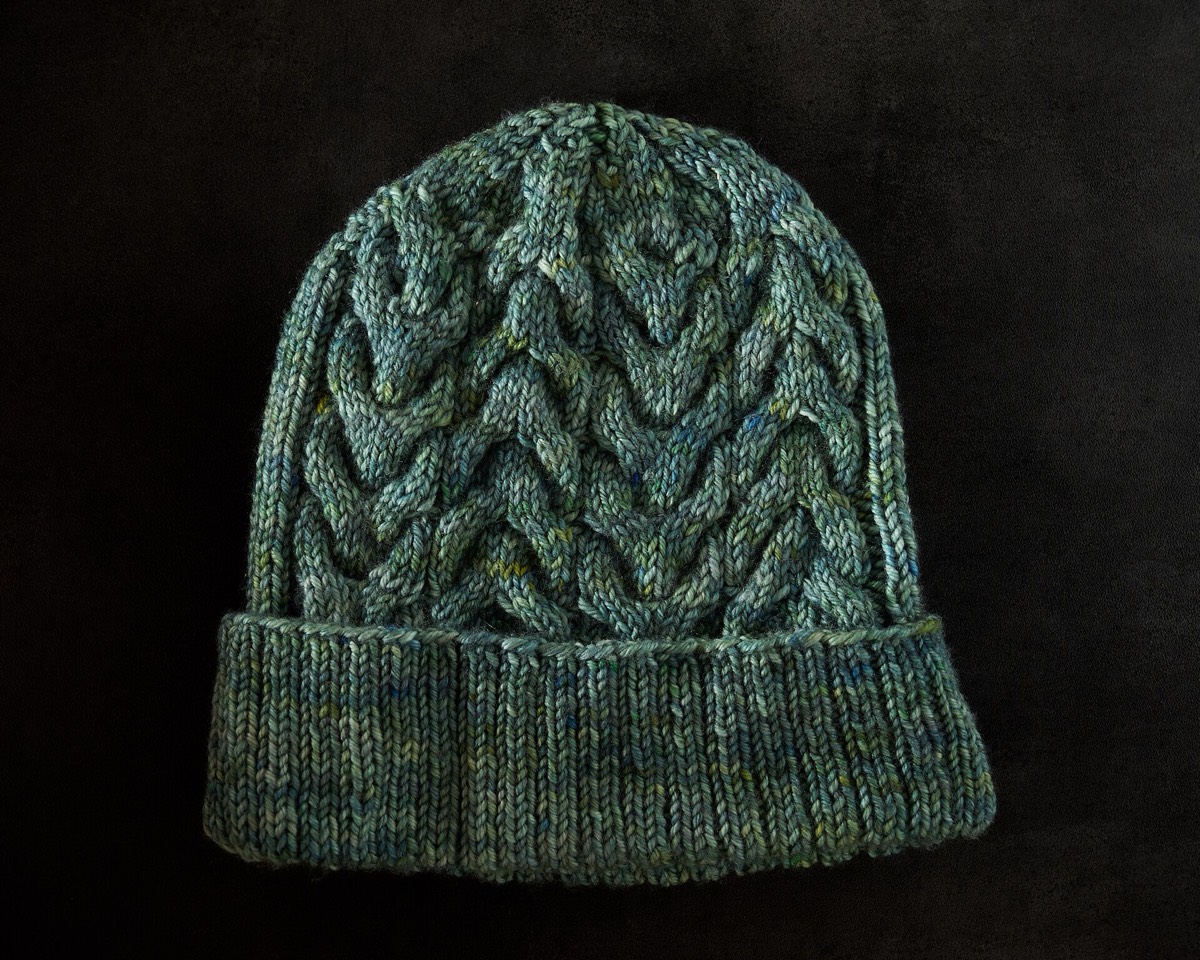

Hats look small enough that one skein should cover them. Often it does; sometimes it does not. A slouchy hat with a folded brim and a pompom can use nearly twice the yarn of a simple beanie, and a cable pattern uses more than stockinette at the same size.
The reliable method is the same as for any other project: estimate the fabric area, weigh a swatch, and add a buffer.
What changes the number
- Head circumference and negative ease. A hat is knitted smaller than the head so it stays on.
- Hat depth. A beanie, a slouch and a folded brim are different amounts of fabric.
- Gauge. A tighter gauge packs more stitches and more yarn into the same area.
- Stitch pattern. Cables, colourwork and textured stitches use more yarn than stockinette.
- Pompom and embellishments. A large pompom can consume 10–20 g on its own.
- Yarn put-up. A 50 g skein may hold less length than expected.
The swatch-weight method
- Knit a swatch at least 15 cm square in the hat's stitch pattern.
- Wash and dry it the way you will treat the hat.
- Measure its area and weigh it in grams.
- Estimate the hat's finished surface area: finished circumference × depth.
- Add 20% for the crown shaping and the brim.
- Multiply by grams per square centimetre, then add a 10–15% buffer.
A worked example
Head circumference 56 cm; finished hat circumference 52 cm (about 7% negative ease); depth 24 cm.
- Area: 52 × 24 = 1,248 cm².
- Add 20% for crown and brim: 1,498 cm².
A 15 × 15 cm swatch is 225 cm² and weighs 12 g. That is 12 ÷ 225 = 0.0533 g per cm².
1,498 × 0.0533 = 79.8 g. Add 15% for swatching and matching: about 92 g.
A 100 g skein is enough. If the yarn comes in 50 g skeins, buy two. A folded brim adds depth — and yarn — so treat 92 g as a minimum if the brim is double-thick.
Negative ease
A hat should be smaller than the head, usually by about 5–10%, so it grips without leaving a mark. Use the finished hat circumference in the area calculation, not the bare head measurement. The stitch count is a separate calculation: finished circumference × stitch gauge, adjusted to the rib multiple.
Brims, crowns and pompoms
A folded brim can add 5–10 cm of depth, which is a significant amount of fabric on a small item. Crown decreases do not use much extra yarn, but the 20% allowance covers them. A pompom is separate: weigh the yarn you intend to use or allow 10–20 g for a medium pompom.
Stitch pattern adds yarn
Cables and colourwork use more yarn per square centimetre than stockinette. If the hat has a large cable panel or stranded pattern, swatch that pattern and add 10–30% depending on density. A stockinette swatch will underestimate the quantity.
Buffer and dye lots
Buy at least 10% more than the calculation suggests, especially if the yarn is dyed in small batches. A second skein in a different lot may be visible on a hat, and a hat is small enough that the difference is hard to hide.
Limits
The area method treats the hat as a tube. It does not account for a very slouchy shape, a folded brim, a large pompom or a complex colourwork pattern. For those, use the pattern's stated yardage as the primary estimate and the swatch method as a cross-check.
Use the quantity method for the estimate, then the cast-on calculator for the stitch count.