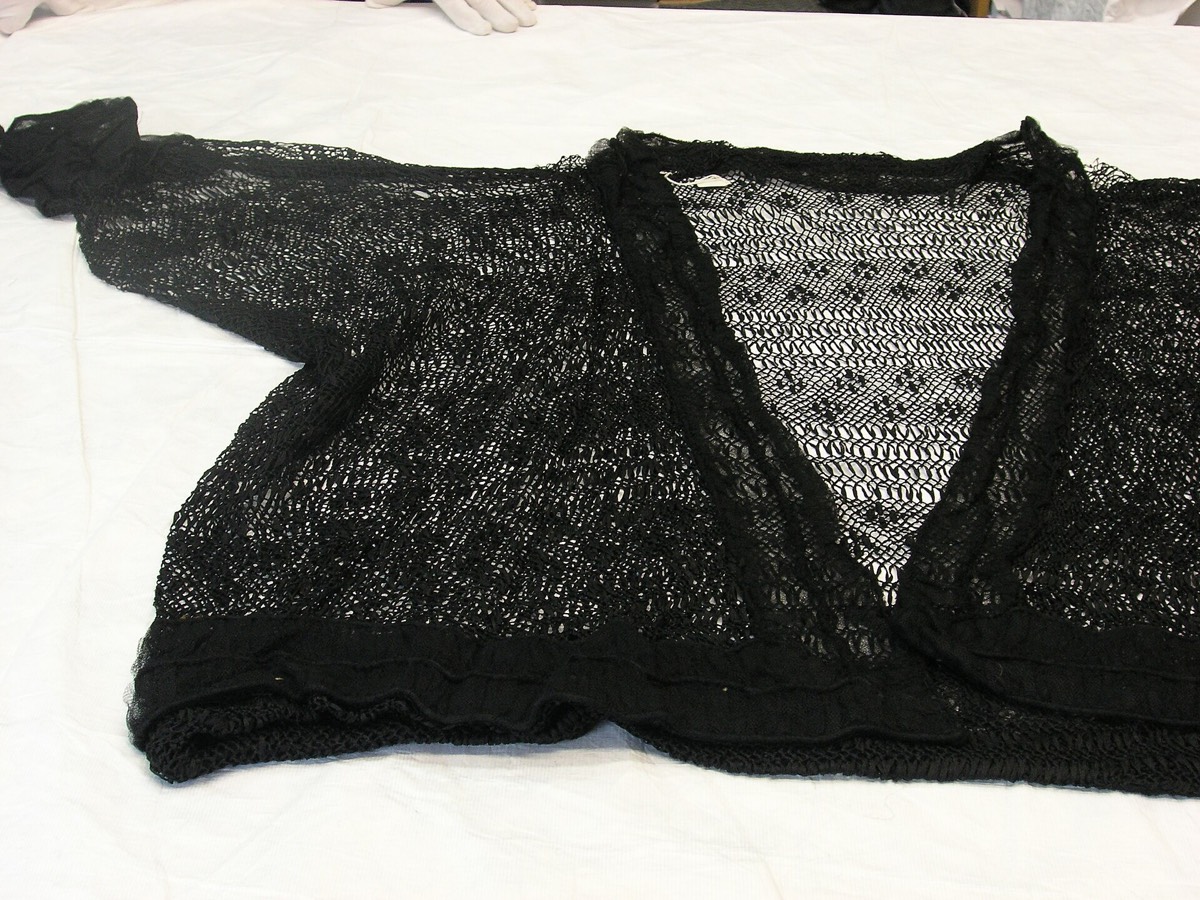

A neckband looks like a simple rectangle of ribbing, but it is a ratio problem. Pick up too few stitches and the band pulls the neckline in; pick up too many and it ripples. The right number depends on the neckline length, the row and stitch gauge, and the rib multiple.
The usual starting ratios are one stitch per bound-off stitch, and three stitches for every four rows along a vertical edge. Then adjust to the rib multiple.
Measure the neckline
Measure the finished neckline along the edge where the band will be picked up. For a shaped neckline, measure each section separately: the back neck, the two front slopes and any bound-off centre stitches. Add the sections to get the total length.
Calculate the pick-up count
- Multiply the neckline length by your stitch gauge per centimetre.
- Adjust the result using the edge ratios: one stitch per bound-off stitch; about three stitches per four rows on a vertical edge.
- Round to the nearest multiple required by the rib: 2 for 1×1, 4 for 2×2, 6 for 3×3.
- Check the result against the pattern's stated pick-up count, if it gives one.
A worked example
Neckline length 60 cm. Stitch gauge 2.4 stitches per cm. 60 × 2.4 = 144 stitches.
A 2×2 rib needs a multiple of 4. 144 is already a multiple of 4, so pick up 144 stitches. For a 3×3 rib, the nearest multiple of 6 is 144 as well; for a 1×1 rib, any even number works.
If the calculation gives 150 and the rib needs a multiple of 4, round to 148 or 152. Choose the side that gives the fit you want: fewer stitches pull in slightly, more stitches relax.
Bound-off edges vs row edges
Along a bound-off edge, pick up one stitch for each bound-off stitch. Along a vertical row edge, pick up about three stitches for every four rows. The row ratio is a starting point; the exact number depends on your row gauge and the shape of the edge.
If the neckline is curved, the ratio changes along the curve. Measure and count in short sections rather than applying one ratio to the whole edge.
Avoiding gaps
- Pick up under both strands of the edge stitch, not just the outer loop.
- Use a needle one or two sizes smaller for the pick-up round, then switch to the band needle.
- Keep the pick-up tension even; do not pull the first stitch tight.
- If a gap appears, close it on the next round by picking up an extra stitch and decreasing it immediately.
Working the band
Work the band in the rib specified by the pattern, usually 1×1 or 2×2. Knit the band to the depth given, then bind off in pattern. A folded neckband may be worked double the depth and sewn or grafted inside; that changes the pick-up count and the yarn quantity.
Picking up around a V-neck
A V-neck has two sloping edges and a centre point. Pick up along each slope at the row ratio, then pick up one stitch at the centre point (or two, depending on the band). Count both slopes separately and adjust the total to the rib multiple; the centre point is where gaps are most likely.
Limits
The ratios are starting points, not rules. A very stretchy rib, a deep V-neck or a loose gauge can need a different count. If the band pulls in or ripples, undo it and adjust by a multiple of the rib; it is a small amount of knitting compared with the body.
Pick up at a rate that matches the edge, and use the cast-on calculator to check the stitch count.