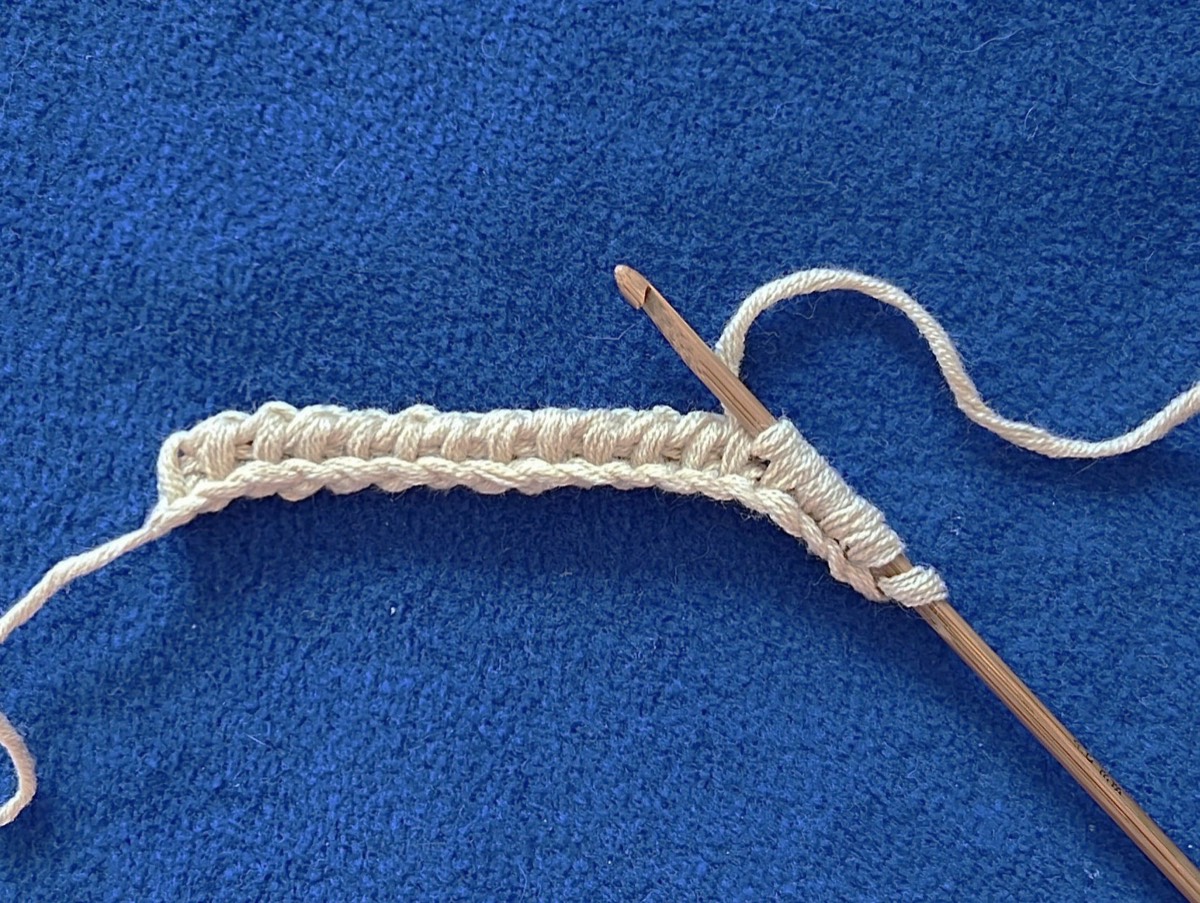

Tunisian crochet sits between knitting and crochet: it uses a long hook, keeps many loops on the hook, and works a forward pass and a return pass. The fabric is dense, textured and often curly. Its gauge behaves differently from both knitting and regular crochet.
If you use a regular crochet gauge for a Tunisian pattern, the size will be wrong. Swatch the Tunisian stitch, measure both directions, and block the swatch before deciding.
Why the gauge is different
- Two passes. The forward pass picks up loops; the return pass works them off. The structure is not a single crochet stitch.
- Dense fabric. Tunisian simple stitch makes a firm, less stretchy fabric, which changes how the finished piece behaves.
- Long hook. The hook holds the full width of the work, so the tool and the fabric weight interact differently.
- Curl. Many Tunisian stitches curl at the edges, especially in simple stitch; blocking and borders can help.
How to swatch Tunisian crochet
- Use a Tunisian hook long enough to hold the full stitch count.
- Work a swatch at least 15 cm square in the pattern's stitch.
- Wash and block it the way you will treat the finished piece.
- Measure stitches and rows over 10 cm, away from the curling edges.
- Check the curl: if the swatch will not lie flat, plan a border or a different stitch.
A worked example
Your Tunisian swatch gives 18 stitches per 10 cm. You want a 100 cm-wide blanket.
18 ÷ 10 = 1.8 stitches per cm; 1.8 × 100 = 180 stitches. If a regular crochet swatch in the same yarn gives 13 stitches per 10 cm, the same 100 cm would need 130 stitches. The two counts are not interchangeable.
The row gauge matters too: Tunisian rows can be taller or shorter than regular crochet rows, so a pattern written in rows may land at a different length.
Hook size
Use the millimetre size the pattern specifies. Tunisian hooks are often longer than regular hooks, and the pattern's gauge assumes a particular hook. Do not substitute a regular hook size simply because the yarn label suggests it; the fabric and the stitch structure decide the gauge.
If you cannot match the gauge with the pattern's hook, change the hook size and re-swatch. A 0.5 mm change can move the stitch count by a stitch or more per 10 cm.
Curling and blocking
Tunisian simple stitch curls because the forward and return passes pull the fabric in different directions. Wet blocking can reduce the curl, and a border of single crochet or a different stitch can hold the edges flat. If the pattern relies on a flat fabric, check the swatch after blocking before committing to a large piece.
Forward and return passes
One Tunisian row is two passes: the forward pass picks up loops, and the return pass works them off. When you measure row gauge, count complete rows, not passes. A pattern that says “10 rows” means ten forward-and-return pairs, not twenty passes.
Hook length and stitch count
The hook must be long enough to hold every stitch in the forward pass. If the stitches crowd the hook, the fabric can distort and the gauge can change. Choose a hook length that matches the project width, not just the yarn weight.
Limits
Tunisian gauge is stitch-specific. A simple stitch swatch cannot predict a Tunisian knit stitch, a honeycomb or a lace pattern. Swatch the stitch you will use, and check both stitch and row gauge. Blocking can change the dimensions, especially in natural fibres.
Check the hook size and the gauge, and use the converter for the metric/US equivalent.