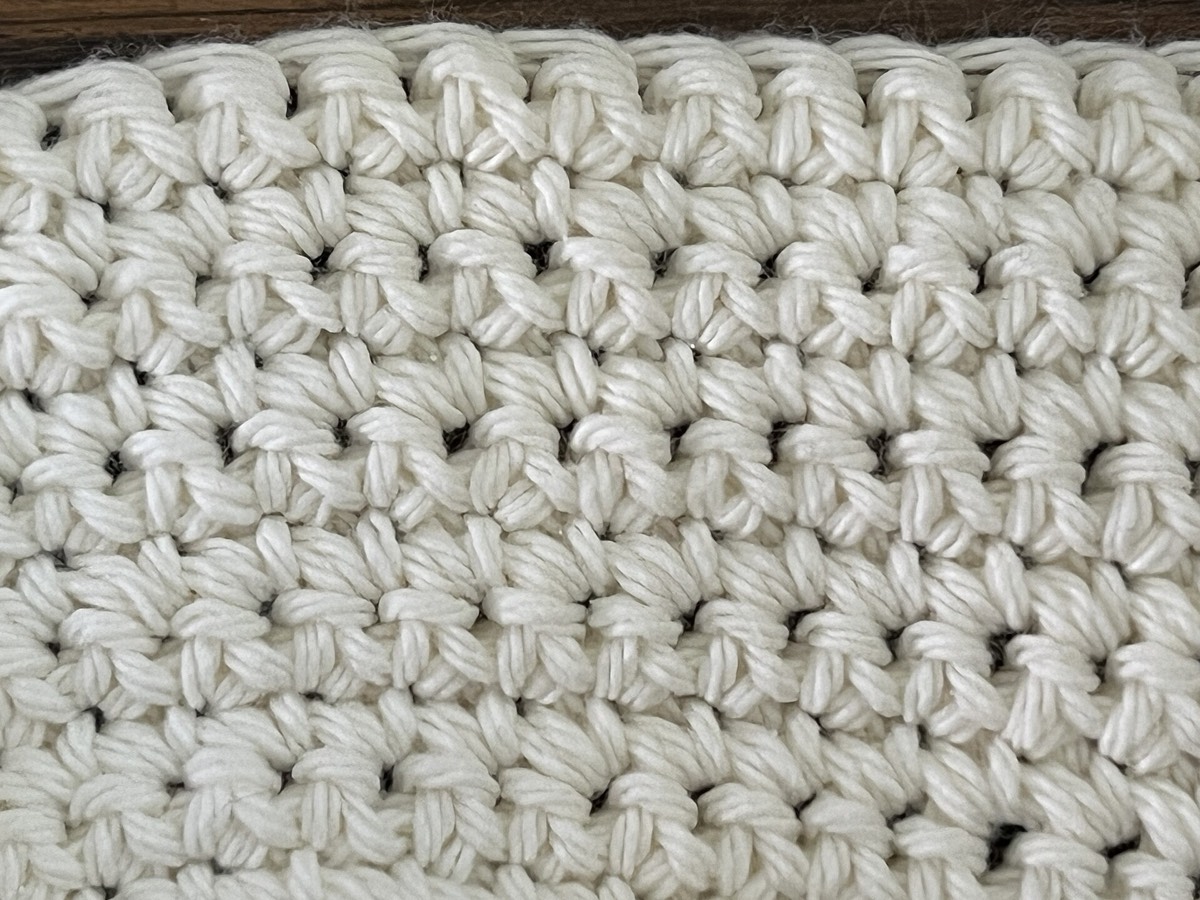

Knitting and crochet can use the same yarn and still produce completely different fabric. Crochet stitches are generally denser, less stretchy and taller than knitting stitches. That is why the Craft Yarn Council publishes separate gauge columns for the two crafts, and why a knitting gauge cannot be used to plan a crochet project.
The same rule applies in reverse: a crochet gauge is not a knitting gauge.
Why the numbers differ
- Stitch structure. A crochet stitch is built from loops pulled through loops; a knit stitch is a loop pulled through a loop. The resulting fabric has different density and stretch.
- Stitch size. For the same yarn weight, crochet usually needs fewer stitches per 10 cm than knitting, but the fabric is denser.
- Row height. Crochet rows are often taller; row gauge is especially different.
- Hook versus needle. The tool and the way the yarn is held change the tension.
Use the crochet column
The CYC Standard Yarn Weight System gives a knitting gauge range and a crochet gauge range for each weight. For a medium-weight yarn, the knitting range is roughly 16–20 stitches per 10 cm in stockinette, while the crochet range is roughly 11–14 single crochet stitches per 10 cm. They describe different fabrics from the same yarn.
If a crochet pattern gives a gauge, it is usually in the stitch the pattern uses — single crochet, half double crochet, or a specific stitch pattern — not in stockinette.
How to measure crochet gauge
- Crochet a swatch at least 15 cm square in the pattern's stitch.
- Wash and dry it the way you will treat the finished object.
- Measure the middle, away from the edges, over 10 cm.
- Count stitches and rows separately; crochet row gauge can be very different from knitting.
A worked example
A knitting swatch gives 18 stitches per 10 cm. A crochet swatch in single crochet gives 13. You want a 50 cm-wide piece.
Knitting: 1.8 stitches per cm × 50 = 90 stitches. Crochet: 1.3 × 50 = 65 stitches.
Using the knitting count for the crochet piece would make it far too wide. The stitch counts are not interchangeable, even though the yarn is the same.
Where it matters most
It matters for garments, blankets and anything where the finished size is specified. It matters less for a free-form project where you are working to a measurement rather than a stitch count. Even then, the crochet fabric will behave differently from a knitted one.
Can you convert a knitting pattern to crochet?
Not by substituting stitch counts. A knitting pattern is drafted around knit fabric: different density, different stretch, different row height. Converting one to crochet requires re-drafting the dimensions, not just changing the stitch. Use the finished measurements as the target and build the crochet fabric to those measurements.
Row gauge matters too
Crochet rows can be much taller than knitting rows, and the ratio changes with the stitch. A pattern written in rows may need more or fewer rows in your gauge. Check the row count against the finished length, not just the stitch count against the width.
Yarn quantity
Crochet usually uses more yarn than knitting for the same area because the fabric is denser. If you are converting a project, do not carry the knitting yardage across; estimate the crochet quantity from a crochet swatch.
Limits
Crochet gauge varies with the stitch pattern and the hook size. A single crochet swatch cannot predict a half double crochet or a textured stitch. Swatch the stitch you will actually use, and check the row gauge as well as the stitch gauge.
For the knitting side see how to measure gauge; for hook sizes see the needle and hook converter.