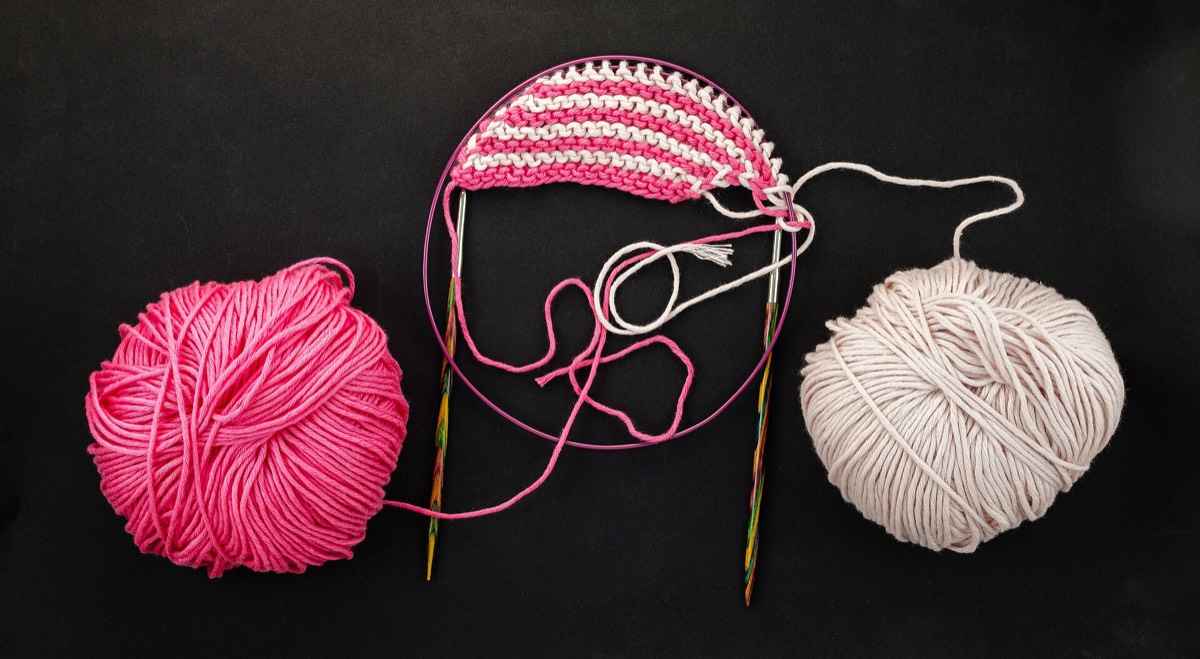

This is a question about the tool, not the fabric structure. Knitting in the round removes the purl rows and can change gauge; that is a separate issue. Here the stitch pattern stays the same — flat stockinette, for example — and only the needle type changes.
Some knitters get the same gauge on straight and circular needles. Others do not. The difference is personal, but it is real enough to test before committing to a large project.
Why the tool can change the number
- Hand position. Circular needles are held differently from two straight needles. The yarn may sit closer to the tips or further back.
- Weight and leverage. Long straight needles and a hanging cable put different weight on the hands and the fabric.
- Needle tips. The taper and sharpness of the tips affect how the yarn is picked up, even at the same millimetre size.
- Fabric support. A circular cable can support a wide piece; straight needles may let it hang from the ends.
None of these is a universal rule. The point is to test your own hands rather than assume.
How to test it
- Choose the same yarn, the same millimetre size and the same stitch pattern.
- Knit one swatch on straight needles and one on circular needles.
- Make both swatches at least 15 cm square, and knit them in the same session if possible.
- Wash and dry both the same way.
- Measure the middle of each swatch, in two or three places.
If the two gauges differ by less than half a stitch per 10 cm, the tool is unlikely to matter for most projects. If they differ by a full stitch or more, use the gauge from the tool you will actually knit with.
A worked example
The straight-needle swatch gives 20 stitches per 10 cm. The circular swatch gives 21. You want a 100 cm body.
At 20 stitches per 10 cm: 200 stitches. At 21: 210 stitches. The difference is 10 stitches, or about 5% of the width — roughly half a garment size.
If you cast on the pattern's 200 stitches and knit on the circulars at 21 stitches per 10 cm, the body measures 95.2 cm. That may be acceptable on a loose garment and unacceptable on a fitted one.
What to do with the result
- Swatch on the tool you will use. This is the simplest fix and removes the question.
- Recalculate the cast-on. Use the circular gauge for a project knitted on circulars, even if the fabric is flat.
- Change needle size, not tool. If you prefer circulars but need the straight-needle gauge, try a 0.25 mm smaller tip and re-swatch.
- Check row gauge too. The tool can change rows as well as stitches.
When it matters most
A half-stitch difference is noise on a scarf. It matters on fitted garments, negative-ease accessories, slippery yarns and long projects where the fabric weight changes as you go. It matters less on blankets and loose accessories, where a few centimetres do not change the function.
The cable is part of the tool
A circular needle is not just a straight needle with a flexible middle. The cable length changes how the fabric hangs and how the stitches move. When you compare circular and straight needles, compare the whole tool: tip shape, cable length and material. A 40 cm circular and a 100 cm circular can feel like different needles even when the tips are identical.
Limits
This test compares tools, not brands. Two circular needles from different manufacturers can have different tip shapes and joins, and that can matter as much as the straight-versus-circular choice. Use the actual needles you plan to knit with.
Swatch on the needles you will actually use, and check the size with the needle converter.