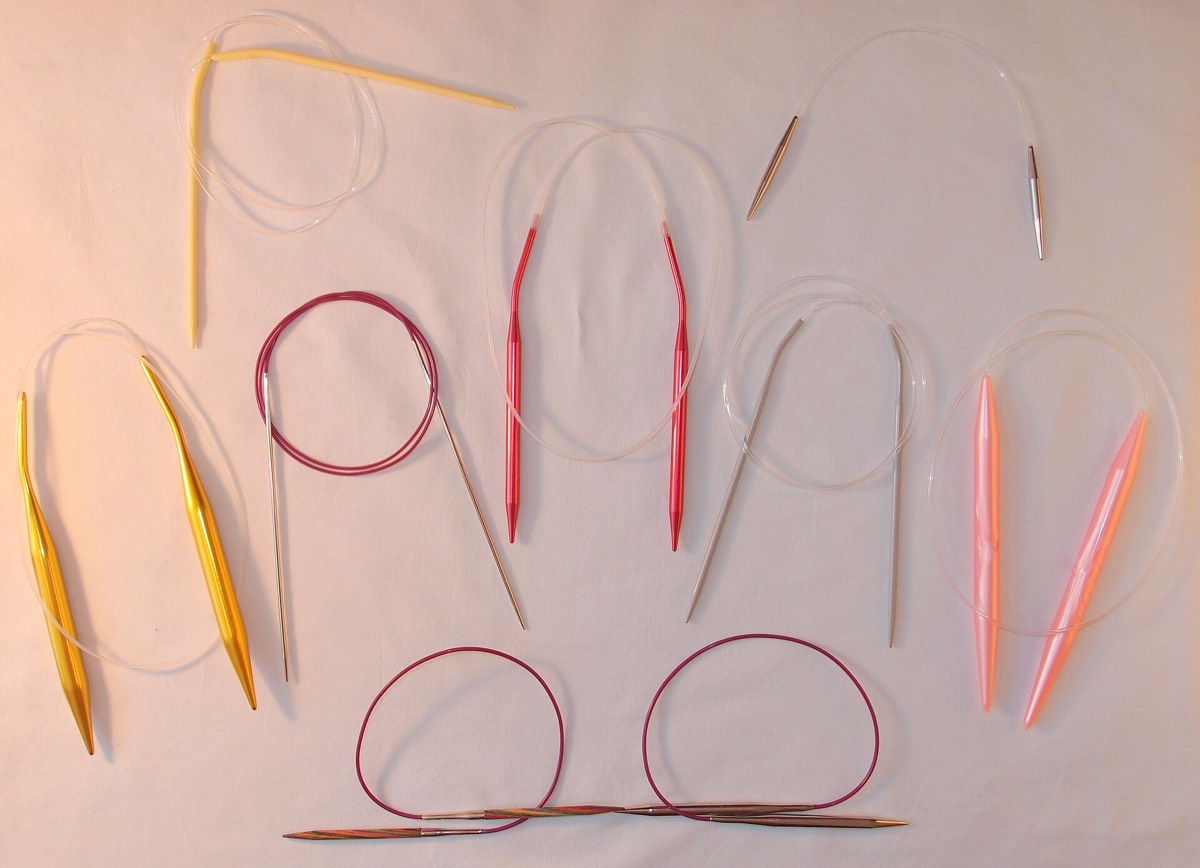

An interchangeable set replaces a drawer of fixed circular needles with a set of tips and cables. The appeal is obvious: fewer purchases, more combinations, and a case that keeps everything together. The catch is that a set is only useful if its size range, cable lengths and joins match the way you knit.
This is a buying checklist, not a brand recommendation. The right set depends on your gauge, your projects and your hands.
What to compare
| Criterion | Why it matters | What to check |
|---|---|---|
| Size range | Most sets skip the extremes | Does it cover the sizes you use most? Are the smallest and largest sizes included or sold separately? |
| Cable lengths | Length decides how many stitches fit comfortably | Are the cables long enough for a sweater body? Short enough for a hat? |
| Join | A ridge at the join catches yarn | Is the transition smooth? Can you feel a lip where the tip meets the cable? |
| Material and tips | Grip and tip shape change the feel | Wood, metal or bamboo? Sharp or rounded tips? Does the material suit your yarn? |
| Tightening mechanism | A loose tip can unscrew mid-project | Is there a key or pin? Does it feel secure? Are replacement parts available? |
| Case and spares | Sets are a long-term purchase | Does the case hold everything? Can you buy single tips, cables and connectors later? |
| Compatibility | Not all systems interoperate | Do the tips and cables belong to the same system? Are adapters needed? |
| Price per size | A set can be false economy | Divide the set price by the number of sizes you will actually use. |
A worked example
A set covers eight sizes from 3.5 mm to 8 mm and includes three cable lengths. It costs about the same as five or six fixed circular needles.
If you regularly use six of the eight sizes, the set is good value. If you knit almost everything on 4 mm and 5 mm, the set is mostly storage. If you need a 2.5 mm tip for socks and the set stops at 3.5 mm, you will still buy fixed needles for the small sizes.
Divide the price by the number of sizes you will actually use, not by the number in the case.
What to check in person
- The join. Run a fingernail across the tip-to-cable transition. A smooth join matters more than a fancy case.
- The cable memory. A cable that stays coiled can be annoying in use; some cables relax with warm water.
- The tightening mechanism. Tighten and loosen a tip a few times. Does it feel secure? Is the key easy to use?
- The size markings. Can you read them without a magnifier? Are they on the tip or only on the case?
- Spare parts. Can you buy a replacement cable or a single tip? A set with no spares is a closed system.
When a set is not worth it
- You knit a narrow range of sizes and already own those fixed needles.
- You mostly knit small circumferences and need short cables or double-pointed needles.
- You travel light and prefer one or two fixed needles.
- You need a size the set does not cover and would have to buy it separately anyway.
Building a set over time
Some systems let you buy tips and cables separately. That can be cheaper than a full set if you only need a few sizes, and it lets you replace a lost tip without buying the case again. Check that the components are compatible across the range and that the manufacturer will continue to stock them.
Limits
This guide does not recommend a brand. Availability, warranty and spare-part support vary by country. Check the return policy and whether the manufacturer sells individual components before committing to a system.
Check the working length and the join, and confirm the sizes with the needle converter.