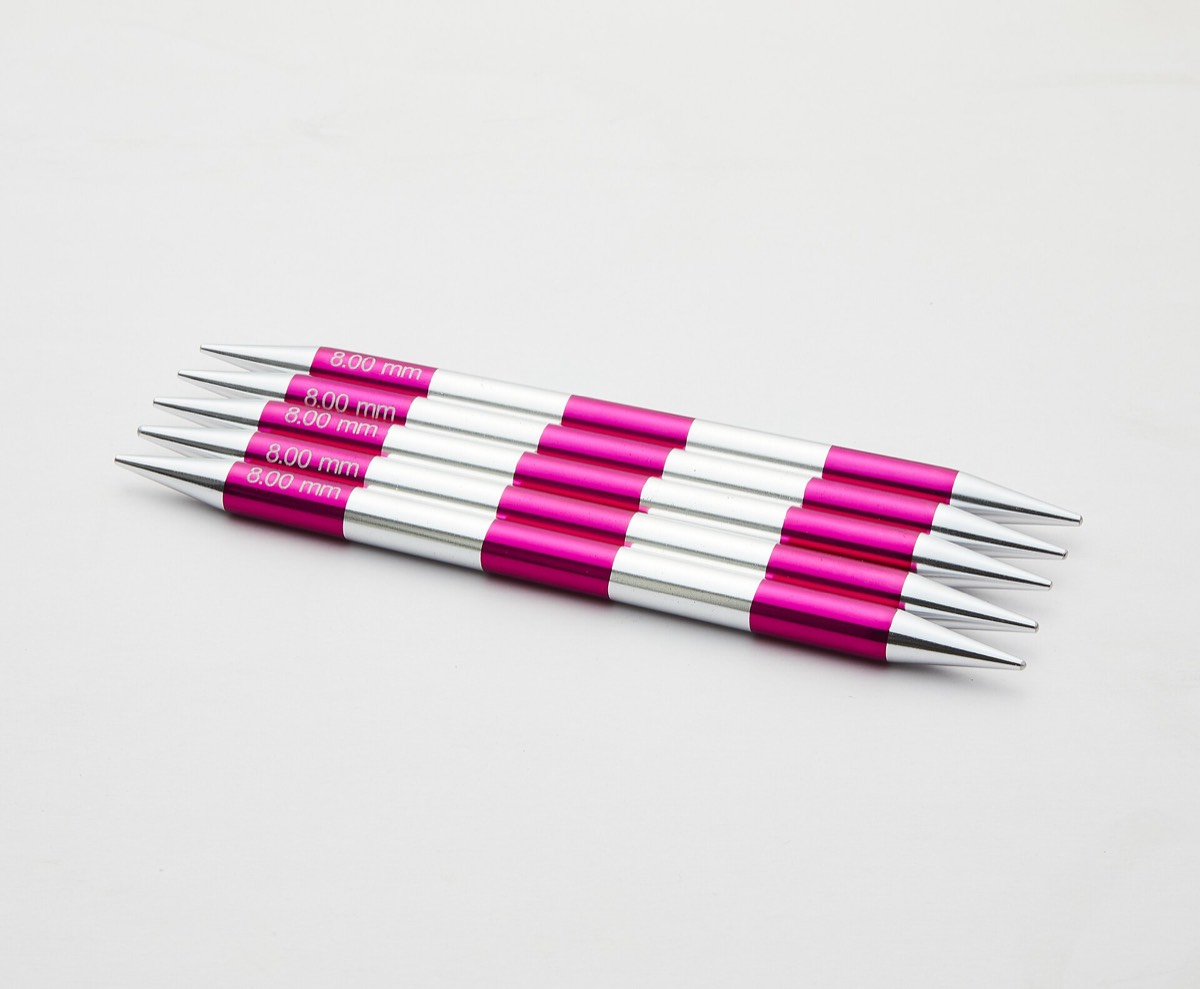

Needle material is one of the most repeated pieces of knitting advice: metal is faster, wood has more grip, bamboo is somewhere in between. The claims are about feel, and feel is personal. The measurable question is simpler: does your gauge change when you change material at the same millimetre size?
Sometimes it does. Sometimes it does not. The only reliable answer is a paired swatch.
What material can change
- Friction. Slick metal lets yarn slide; wood and bamboo grip. More grip can mean tighter stitches for some knitters, or more uneven tension for others.
- Weight. Metal needles are often heavier; wood and bamboo are lighter. The weight changes how the needle sits in the hand.
- Temperature. Metal feels cooler at first; this changes how some knitters hold the needle, especially in cold rooms.
- Tip shape. Two needles of the same material can have different tapers and sharpness, which affects how the yarn is picked up.
These effects are not universal, and they are not a reason to buy a new set without testing.
How to test it
- Use the same yarn and the same millimetre size. Check the size marking; do not assume two needles labelled “US 7” are identical.
- Knit one swatch on each material, in the same stitch pattern.
- Make both at least 15 cm square and knit them under similar conditions.
- Wash and dry both the same way.
- Measure the middle of each swatch and compare stitches and rows.
If the difference is less than half a stitch per 10 cm, material is unlikely to matter for most projects. If it is a full stitch or more, use the gauge from the material you will knit with.
A worked example
A metal needle gives 20 stitches per 10 cm. A wooden needle of the same size gives 21. You want a 100 cm body.
At 20 stitches per 10 cm: 200 stitches. At 21: 210 stitches. The difference is 10 stitches, about 5% of the width.
If you cast on 200 stitches and knit on the wooden needle at 21 stitches per 10 cm, the body measures 95.2 cm. On a loose garment that may be fine; on a fitted one it is half a size.
What to do with the result
- Swatch on the material you will use. This is the only way to remove the variable.
- Keep the material and change the needle size. A 0.25 mm change may close the gap; re-swatch.
- Keep the gauge and recalculate. Use the gauge from your chosen needles for the cast-on and shaping.
- Check row gauge. Material can change rows as well as stitches.
When it matters most
Material is more likely to matter with slippery yarns, loose gauges, long projects and knitters who rely on the yarn sliding against the needle. It matters less on a small, forgiving project where a half-stitch difference disappears in the finished object.
Check the size, not just the material
Two needles marked US 7 are not guaranteed to measure the same. Manufacturing tolerances and the way the size is printed can differ. Before comparing materials, measure the shaft with calipers or check both needles against a needle gauge. If the sizes differ, the test is measuring the size, not the material.
Limits
This test compares materials, not brands. Two wooden needles can have different finishes, and two metal needles can have different coatings. Needle size accuracy also varies. Use the actual needles you plan to knit with, and treat the result as a personal measurement rather than a general rule.
Test both materials on the same yarn; the circular vs straight comparison is the same test in another form.