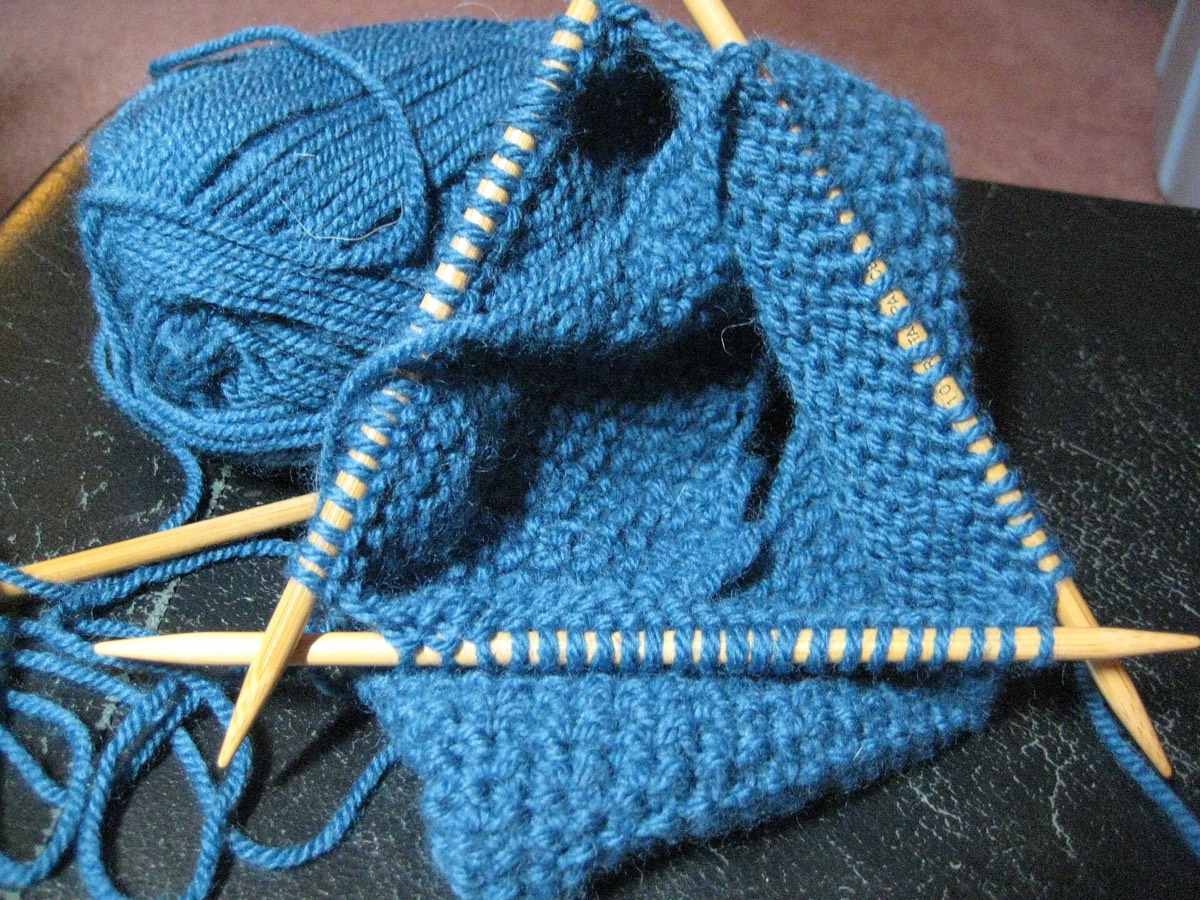

Socks, mittens, hat crowns and sleeve cuffs all share a problem: the circumference is too small for a standard circular needle. There are three common solutions — double-pointed needles, the magic-loop method and short circular needles — and they are not interchangeable in comfort.
The right choice depends on stitch count, the circumference, and how much cable management you are willing to do.
The three methods
| Method | Best for | Strength | Watch for |
|---|---|---|---|
| Double-pointed needles | Socks, mitts, hat crowns | No long cable; stitches are easy to see | Ladders at the joins; several tips to manage |
| Magic loop | Socks, sleeves, hats | One long cable; portable; works for many circumferences | Loop management; gaps at the pull points |
| Short circular | Hats, socks when the circumference fits | Fast; few tips; familiar rhythm | Fixed length; crowded stitches if the circumference is too small |
| Traveling loop | Small circumferences with a long cable | One cable; no second needle | Similar loop management to magic loop |
Choose by circumference
Start with the finished circumference, not the stitch count alone. A 23 cm short circular is designed for small circumferences, but it is tight for a 20 cm sock. A 40 cm circular is the usual choice for a hat body, even though the fabric bunches slightly. Magic loop uses an 80–100 cm cable and pulls the excess cable out at one or two points.
- 20 cm sock: magic loop on an 80 cm cable, or double-pointed needles. A 23 cm circular is likely to feel crowded.
- 50 cm hat: a 40 cm circular for the body, with the fabric slightly bunched; switch to double-pointed needles or magic loop for the crown.
- 35 cm sleeve: a 30 cm circular, magic loop, or double-pointed needles.
- Hat crown: double-pointed needles or magic loop, because the circumference shrinks below the short circular's comfortable range.
A worked example
A sock has 64 stitches at 32 stitches per 10 cm, so the finished circumference is 20 cm. A 23 cm circular leaves only 3 cm of slack; the stitches will be crowded and may distort the fabric.
An 80 cm cable in magic loop gives plenty of slack. The excess cable is pulled out at one side, and the stitches sit on two needle tips. The same 64 stitches can be worked without changing the needle.
Ladders and gaps
Ladders are loose columns of stitches at the transition between needles. They are more common with double-pointed needles and magic loop, where the yarn has to travel across a gap. Tighten the first stitch after the join, give the yarn a small tug, and move the transition point every few rounds if the problem persists.
With magic loop, the pull points can also leave a gap. Keep the loop tight and work the first stitch firmly. If the gap remains, try shifting the loop by a stitch or two each round.
What about gauge?
Changing method can change gauge, especially if the needle size or the way you hold the fabric changes. If you are switching from a short circular to magic loop for the crown, check that the stitch gauge stays consistent. A crown is small, so a small gauge shift matters less than on a sweater body, but it is still worth a glance.
Changing method mid-project
You can switch from a short circular to double-pointed needles or magic loop when the circumference gets too small. Keep the same stitch count and the same needle size; the change is in how the stitches are distributed, not in the fabric. Mark the beginning of the round so the transition does not shift the pattern.
Limits
Comfort is personal. Some knitters hate double-pointed needles; others find magic loop fiddly. Try all three on a small project before buying a full set of one system. The method that lets you knit evenly is the right one, even if it is not the most popular.
Choose the method, then confirm the cable length and size with the needle converter.