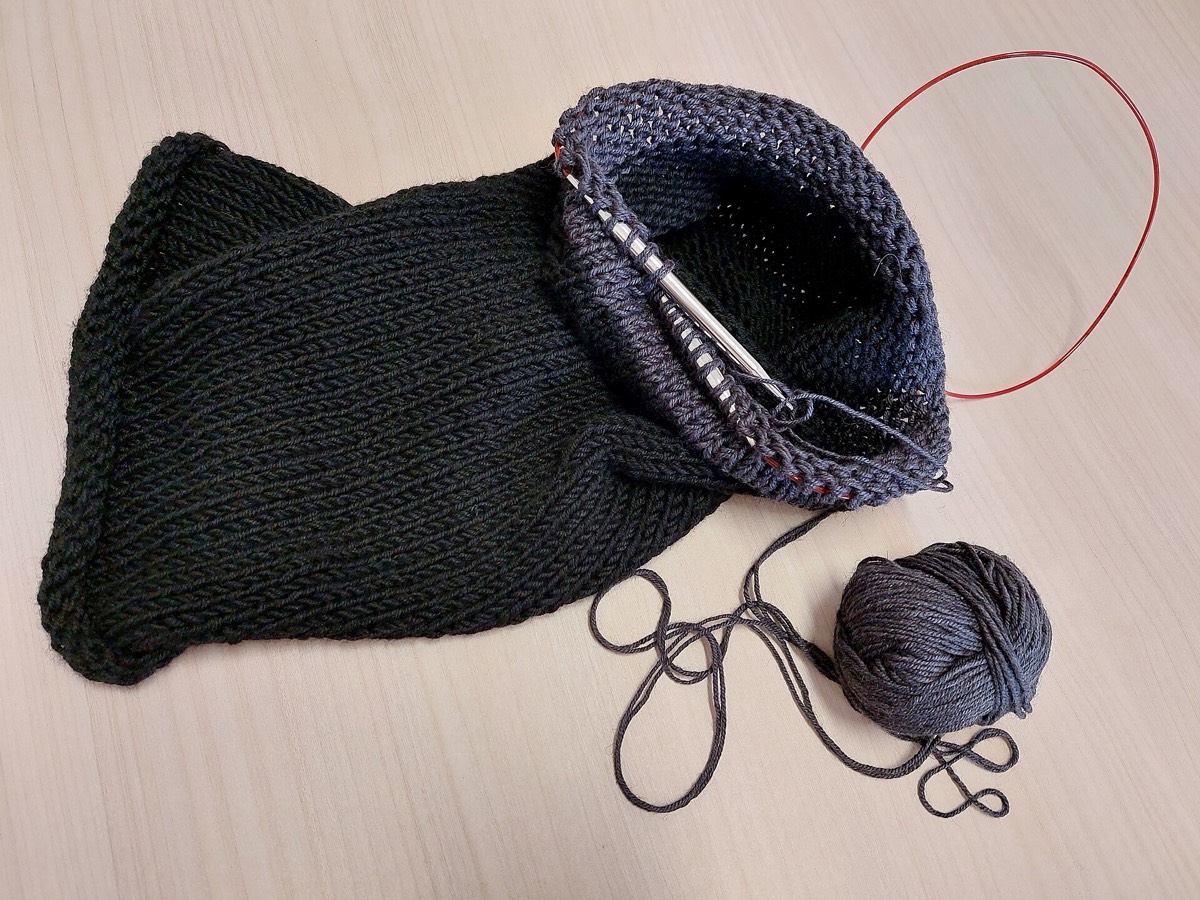

Many knitters get a different gauge in the round than they do working flat. The stitches are the same; the row structure is not. In the round you knit every row, while flat knitting alternates knit and purl rows. If your purl stitches are tighter or looser than your knit stitches, the two fabrics will not measure the same.
The practical rule is simple: swatch the way you will knit. If the project is a hat, sweater body or sock tube, make a circular swatch. If you cannot, use a flat swatch with the knowledge that the row gauge — and sometimes the stitch gauge — may shift.
Why the gauge changes
- Purl rows. Many knitters work purl stitches at a different tension from knit stitches. Flat stockinette contains both; circular stockinette contains only knits.
- Needle position. Circular needles and double-pointed needles sit in the hands differently from two straight needles. The yarn may be held closer or farther from the tips.
- Weight of the fabric. A large circular piece hangs from the cable; a flat piece rests on the needles or the table. The fabric can stretch differently as it grows.
- Colourwork and texture. Floats, cables and pattern repeats behave differently when every round is worked on the right side.
How to swatch in the round
- Cast on enough stitches for a 15 cm circumference. At 20 stitches per 10 cm, that is about 30 stitches.
- Join without twisting, place a marker, and knit a tube at least 15 cm long.
- Bind off, wash and dry the tube the way you will treat the finished object.
- Measure across the middle of the tube, away from the cast-on and bind-off edges. Count stitches around the circumference and rows vertically.
A narrow tube curls at the edges, but the middle is knit-only fabric and is exactly what you need. If the tube is too small to measure comfortably, cast on for 20 cm instead.
A worked example
Your flat swatch gives 20 stitches per 10 cm. Your circular swatch gives 22. You want a 100 cm body.
At the flat gauge: 2 stitches per cm × 100 cm = 200 stitches. At the circular gauge: 2.2 × 100 = 220 stitches. That is 20 stitches — a full size — between the two readings.
If the pattern was written for flat knitting and you convert it to the round, do not assume the stitch count transfers. Swatch the circular fabric, then recalculate the cast-on and the shaping.
What to do if the numbers differ
- Swatch again on a different needle. A 0.25–0.5 mm change can close a small gap, but check that the fabric still feels right.
- Keep the circular gauge and recalculate. Use the circular gauge for the cast-on and for any stitch counts that depend on width.
- Check row gauge separately. Circular knitting can change rows even when stitches stay the same, especially in colourwork.
- Do not mix gauges silently. If the body is worked in the round and the sleeves flat, swatch both if the fit is close.
When it may not matter
A difference of one stitch per 10 cm is small on a scarf or a loose blanket. On a fitted garment it is a size. The looser the gauge and the more forgiving the shape, the less the difference matters; the closer the fit, the more it does.
Limits
A circular swatch is still a sample. Large circular pieces can stretch under their own weight, and colourwork can tighten the fabric as the floats accumulate. Measure the swatch after washing, and check the real project after the first few inches.
Measure both flat and in the round before deciding; the gauge method is the same, but the fabric may not be.