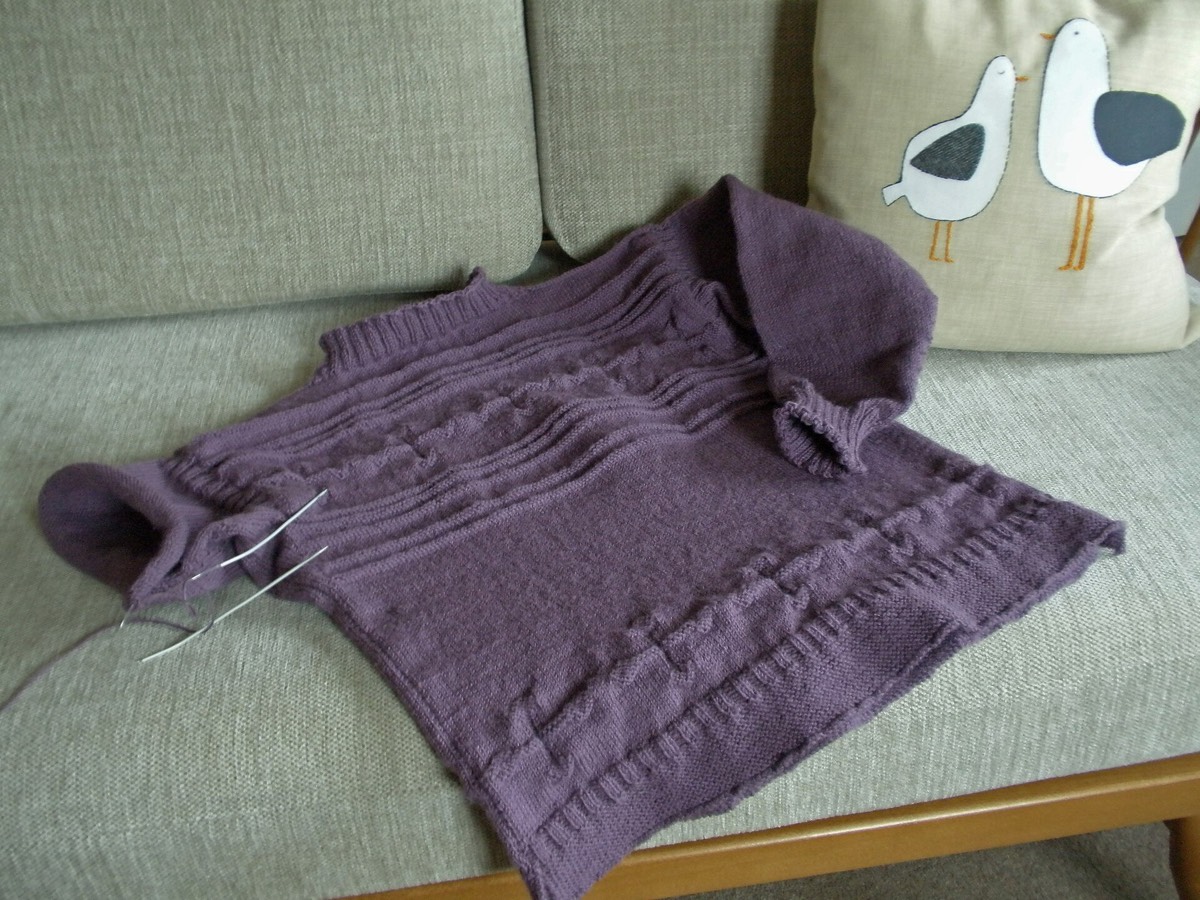

There is no single yardage for “a sweater”. Two sweaters in the same size can use different amounts of yarn because one is cropped and loose and the other is long and fitted; because one is stockinette and the other is cabled; because one knitter works at 18 stitches per 10 cm and another at 22.
The reliable method is to estimate the fabric area, weigh a swatch, and multiply. It takes a little arithmetic, but it is specific to your size, your gauge and your yarn.
What changes the number
- Size and ease. A 100 cm chest and a 120 cm chest are different amounts of fabric, even in the same nominal size.
- Body and sleeve length. Area grows with both dimensions. A 5 cm longer body is a measurable amount of yarn.
- Gauge. A tighter gauge packs more stitches — and more yarn — into the same area.
- Stitch pattern. Cables, colourwork and textured stitches use more yarn than stockinette.
- Yarn density. Two yarns in the same weight can have different metres per 100 g.
- Buffer and dye lots. Swatching, seaming and a late extra skein all consume yarn that is not in the finished measurements.
The swatch-weight method
- Knit a swatch at least 15 cm square in the project's stitch pattern.
- Wash and dry it the way you will treat the sweater.
- Measure its area in square centimetres and weigh it to the nearest gram.
- Divide the weight by the area to get grams per square centimetre.
- Estimate the sweater's surface area: body plus both sleeves.
- Multiply area by grams per square centimetre, then add a buffer.
For a sweater, the body area is approximately chest circumference × body length. A sleeve is approximately upper-arm circumference × sleeve length. Tapered sleeves mean this is a slight overestimate, which is the safer direction to be wrong in.
A worked example
You want a 100 cm chest, a 60 cm body, and sleeves 40 cm around and 55 cm long.
- Body: 100 × 60 = 6,000 cm².
- Sleeves: 40 × 55 = 2,200 cm² each, so 4,400 cm² for both.
- Total: 10,400 cm².
A 15 × 15 cm swatch is 225 cm² and weighs 12 g. That is 12 ÷ 225 = 0.0533 g per cm².
10,400 × 0.0533 = 554 g. Add 15% for swatching, seaming and matching the pattern: about 637 g.
Convert to skeins using the put-up. At 100 g per skein, buy 7. At 50 g per skein, buy 13. Check the metres as well: if the skein holds 200 m, 7 skeins give 1,400 m; if it holds 100 m, 13 skeins give 1,300 m. The substitution calculator can do the metres-to-skeins step once you know the length you need.
Stitch pattern adds yarn
Stockinette is the baseline. Cables pull in and use more yarn per square centimetre; stranded colourwork adds floats; textured stitches can use more or less depending on how much they compress the fabric. Swatch the dominant pattern, not just stockinette.
If you are estimating from a stockinette swatch and the project has a large cable panel, add 10–30% depending on the density of the pattern. The exact figure depends on the design; the direction is always the same.
Buffer and dye lots
Buy at least 10% more than the calculation suggests. Fifteen percent is safer for a new-to-you fibre or a complex stitch pattern. Buy all the skeins at once, in one dye lot. A late extra skein in a different lot is the most common way a finished sweater gets a visible stripe.
Buffer is not waste. Leftover yarn is cheaper than a mismatched late skein, and it is useful for repairs.
Cross-check with a pattern
If you are knitting an existing pattern, its stated yardage is still useful as a cross-check. Compare its gauge, size and stitch pattern with yours. If the pattern is for a 110 cm chest at 18 stitches per 10 cm and you are knitting 100 cm at 22 stitches, the numbers are not transferable without adjustment.
Limits
The area method assumes a roughly rectangular body and sleeves. It does not account for deep yoke shaping, oversized sleeves, long cuffs or a very loose gauge. For those shapes, measure a garment you already own or use the pattern's yardage as the primary estimate and the swatch method as a sanity check.
For the full method see how much yarn do I need; for the gauge input see how to measure gauge.