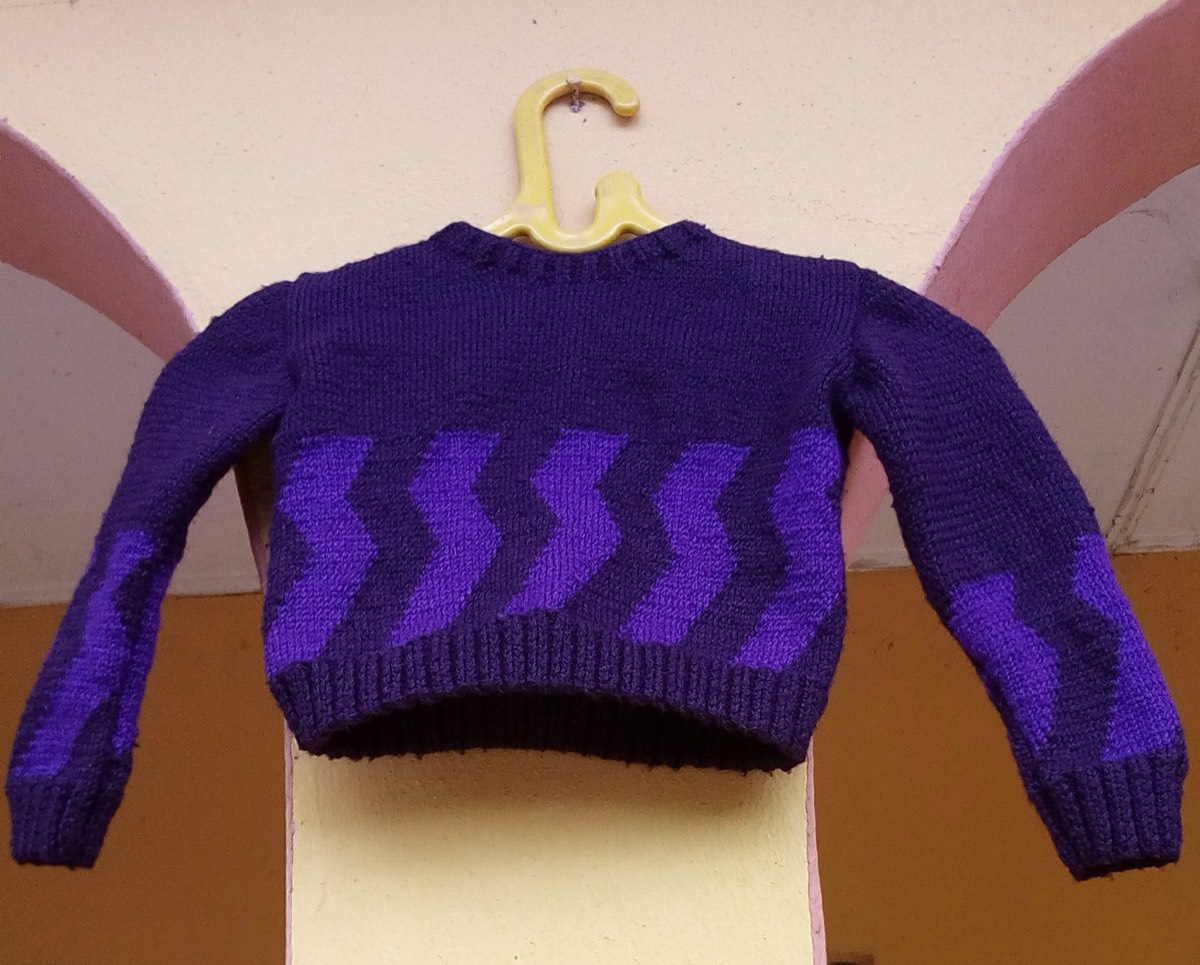

Sometimes you do not have a swatch. You have a sweater you already wear, a jumper from a charity shop, or a finished project whose notes are long gone. You can still recover a useful gauge from the fabric — as long as you measure the right part of it.
This is not a substitute for swatching a new yarn, but it is enough to estimate a cast-on, compare an old project with a new pattern, or work out what needle size probably produced the fabric.
When this is useful
- You want to knit a second version of a garment and the pattern is unavailable.
- You are matching the gauge of a favourite shop-bought knit.
- You need to estimate the yarn quantity or weight of an existing piece.
- You are checking whether a finished project actually matched its intended gauge.
What you need
A flat surface, a rigid ruler or a measuring tape that does not stretch, two pins, and a garment that is clean and relaxed. If the garment has just been worn, let it rest flat for a few hours; cuffs and hems recover at different rates.
Where to measure
Measure a plain stockinette area in the middle of a large panel. On a sweater, that usually means the body above the ribbing and below the underarm, away from the side seam and the centre front. On a sleeve, use the middle of the upper arm, not the cuff.
Avoid:
- ribbing, which pulls in;
- seams and folded edges;
- cuffs and hems that have stretched with wear;
- felted, pilled or visibly distorted areas;
- colourwork or cable panels unless that is the gauge you need.
How to measure
- Lay the garment flat and smooth it with your hand. Do not pull it to remove wrinkles.
- Place two pins exactly 10 cm apart horizontally in the stockinette area.
- Count the stitches between the pins. Repeat in two or three places.
- Place two pins 10 cm apart vertically and count the rows the same way.
- Measure the garment's key dimensions as well: chest width, body length, sleeve length, and the width at the cuff.
The dimensions matter because they let you convert stitch counts back into lengths. A gauge without a garment measurement can tell you density; it cannot tell you where the shaping happened.
A worked example
A favourite sweater measures 50 cm across the chest. Counting between pins gives 100 stitches across that width. That is 100 ÷ 50 = 2 stitches per cm, or 20 stitches per 10 cm.
The body is 30 cm long from the underarm to the hem, and the row count over that distance is 120 rows. That is 4 rows per cm, or 40 rows per 10 cm.
If a new pattern asks for 18 stitches and 24 rows per 10 cm, the old sweater is denser in both directions. The fabric will be firmer at the same yarn weight. You can use the old numbers to plan a project at that gauge, or go up a needle size and swatch to reach the pattern's gauge.
Caveats
A worn garment is not a fresh swatch. Cotton and alpaca grow; superwash wool relaxes; ribbing loses memory; elbows and seats stretch. Treat the recovered gauge as a range, not a precise figure, and measure more than one area.
You also cannot know the original needle size from the fabric alone. Two needle sizes can produce similar gauge in different hands, and the yarn's fibre and spin change the fabric as much as the needle does. Use the recovered gauge to choose a starting needle, then swatch.
Using the number
Multiply stitches per cm by the finished width you want. For a 55 cm body at 2 stitches per cm, cast on 110 stitches. Use the cast-on calculator if you want the unit conversion and rib snapping handled for you.
For quantity, combine the gauge with the garment area and a swatch weight, or use the substitution calculator to convert metres into skeins.
Questions
Can I use a shop-bought sweater as a swatch?
Yes, for estimating gauge and dimensions. Treat the result as a range, and remember that the original yarn and needle are unknown.
Should I measure before or after washing?
Measure after washing and drying flat, because that is the fabric you will wear. If you cannot wash it, measure a relaxed area and accept more uncertainty.
What if the gauge varies across the garment?
Measure two or three areas and use the middle value. Large differences usually mean the fabric has stretched unevenly or the garment was knitted at a different tension in different sections.
Limits
A finished garment gives you a useful range, not a laboratory measurement. Wear, washing and the original needle are unknown, and the fabric may have stretched unevenly. Use the number to choose a starting needle and to estimate yardage, then swatch the new yarn. Do not treat a recovered gauge as a guarantee that the same stitch count will fit the same way.