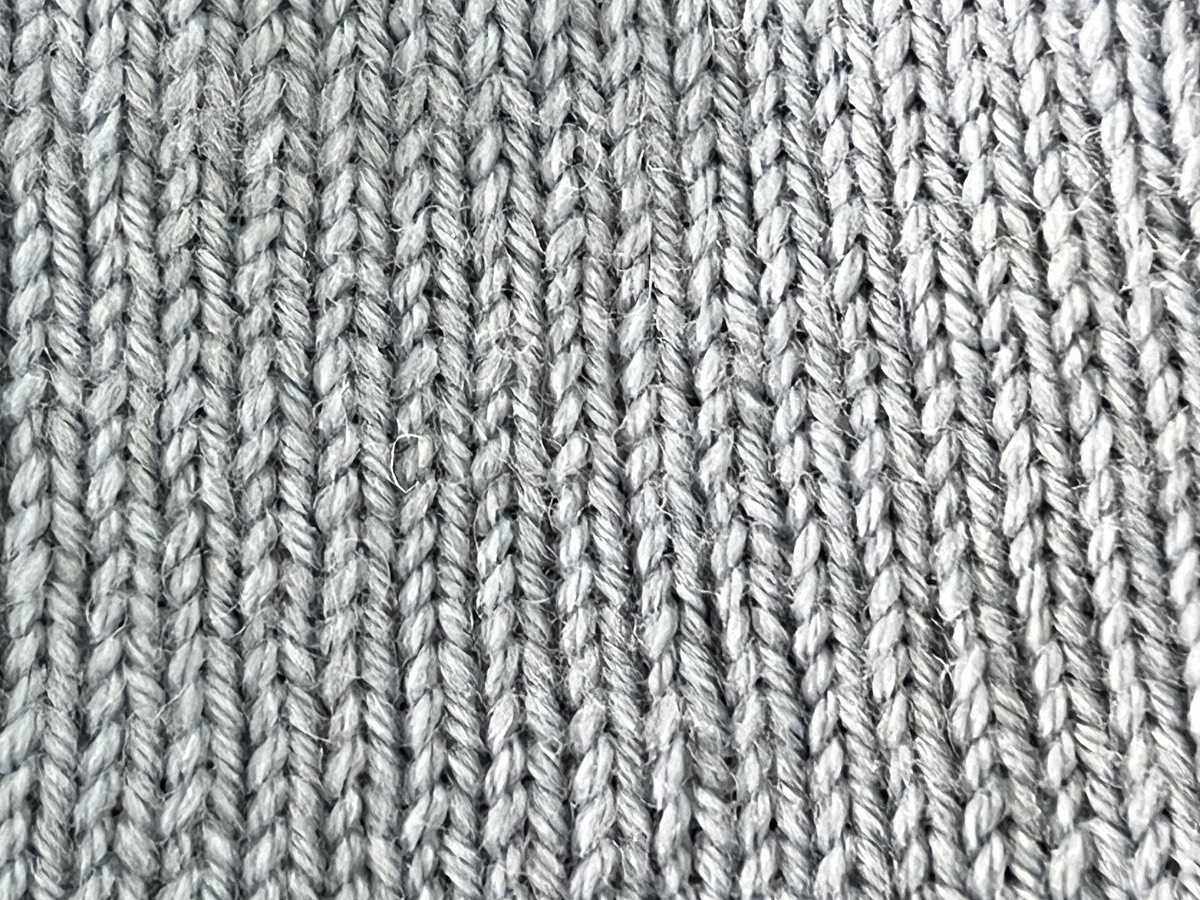

Stitch gauge gets the attention because it decides width. Row gauge decides height, and in a shaped garment height is where the fit quietly goes wrong.
This guide covers what row gauge is, how to measure it on the same swatch, when a pattern actually depends on it, and what to do when your row count and stitch count disagree.
What row gauge is
Row gauge is the number of rows that fit into 10 cm (or 4 in) of fabric. Like stitch gauge, it is only meaningful when you state the pattern and the finishing: “24 rows per 10 cm in stockinette, after washing and drying flat” is a measurement. “24 rows” on its own is not.
Row gauge is not a second copy of stitch gauge. A needle change can move one without moving the other by the same amount, and different stitch patterns compress or open the vertical dimension in different ways.
How to measure it
- Use the swatch you already washed and dried the way you will treat the finished object. Unwashed row gauge is a different number.
- Lay the swatch flat without stretching it. If it curls, pin the corners lightly without distorting the fabric.
- Place two pins exactly 10 cm apart vertically, away from the cast-on and bind-off edges.
- Count the rows between the pins, including the row at one pin but not the other. Count whole rows only.
- Repeat in two or three places. If the counts differ by more than one row, the fabric is not settled or the swatch is distorting; wet it again and remeasure.
Measure in the stitch pattern you will actually knit. Ribbing compresses vertically, cables pull the fabric in, stranded colourwork often shortens rows, and lace opens them. A stockinette row count cannot predict a cabled panel.
When row gauge matters
- Raglans and set-in sleeves. Increase and decrease rates are written in rows. If your rows are shorter, the shaping happens too quickly and the armhole ends up shallow.
- Armhole depth and sleeve caps. These are vertical measurements built from row counts, not just stitch counts.
- Vertical pattern repeats. Lace, colourwork and stitch dictionaries often specify a number of rows. A different row gauge changes where the repeat lands.
- Patterns written in rows. “Knit 60 rows” is a different instruction from “knit until the piece measures 20 cm”.
- Short rows. The number of wrap-and-turn points and the rate at which they are worked both depend on row gauge.
When it does not
Scarves, blankets and plain sweater bodies are often written by length. If the pattern says “work until the body measures 38 cm”, you can use a tape measure and ignore the row count. The same applies when you deliberately resize a simple shape: knit to the measurement, not to a row number.
Even then, row gauge tells you how much yarn the vertical dimension will consume. It is a quantity input even when it is not a shaping input.
A worked example
The pattern asks for 32 rows per 10 cm. Your swatch gives 36. The armhole is 20 cm deep. At the pattern gauge that is 64 rows; at yours it is 72 rows — eight rows more.
If the raglan decreases every other row, those eight rows contain four extra decrease rounds. If each round removes two stitches, that is eight extra stitches removed before the neck shaping even begins. That is enough to change the fit.
You have three honest options:
- Change the needle. Go up a size and re-swatch. Check that stitch gauge does not move out of range; if it does, this is not a free fix.
- Recalculate the rate. Multiply the pattern's row counts by 36 ÷ 32 = 1.125. A decrease every 8 rows becomes a decrease every 9 rows.
- Work by length. Convert the pattern's row intervals to centimetres at the pattern gauge, then measure those intervals on your knitting. Eight pattern rows are 2.5 cm; at your gauge, place the decrease when the piece measures 2.5 cm, which is about nine rows.
Do not try to force both gauges with one needle change if the fabric becomes too loose or too dense. Decide which gauge the pattern depends on, and protect the fabric.
Limits
Blocking can change row gauge more than stitch gauge, especially in superwash wool, alpaca and lace. Measure after washing, and measure again after the garment has hung for a day if it will be worn hanging. Row gauge can also drift across a large piece as your tension changes; a mid-project check is more useful than a single swatch number.
Questions
Is row gauge less important than stitch gauge?
Often, but not always. It matters most in shaped garments and vertical repeats, and least in simple pieces knit to a measurement.
Why is my row gauge off when my stitch gauge is right?
Needle size, technique and stitch pattern affect the two dimensions differently. Check the row count in the pattern you will actually knit, not just in stockinette.
Can I convert a row count to a length?
Yes. Rows per centimetre = rows per 10 cm ÷ 10. Multiply the pattern's row count by that figure to get the length it represents at your gauge.
Compare row and stitch gauge in one swatch; use the cast-on calculator once set.