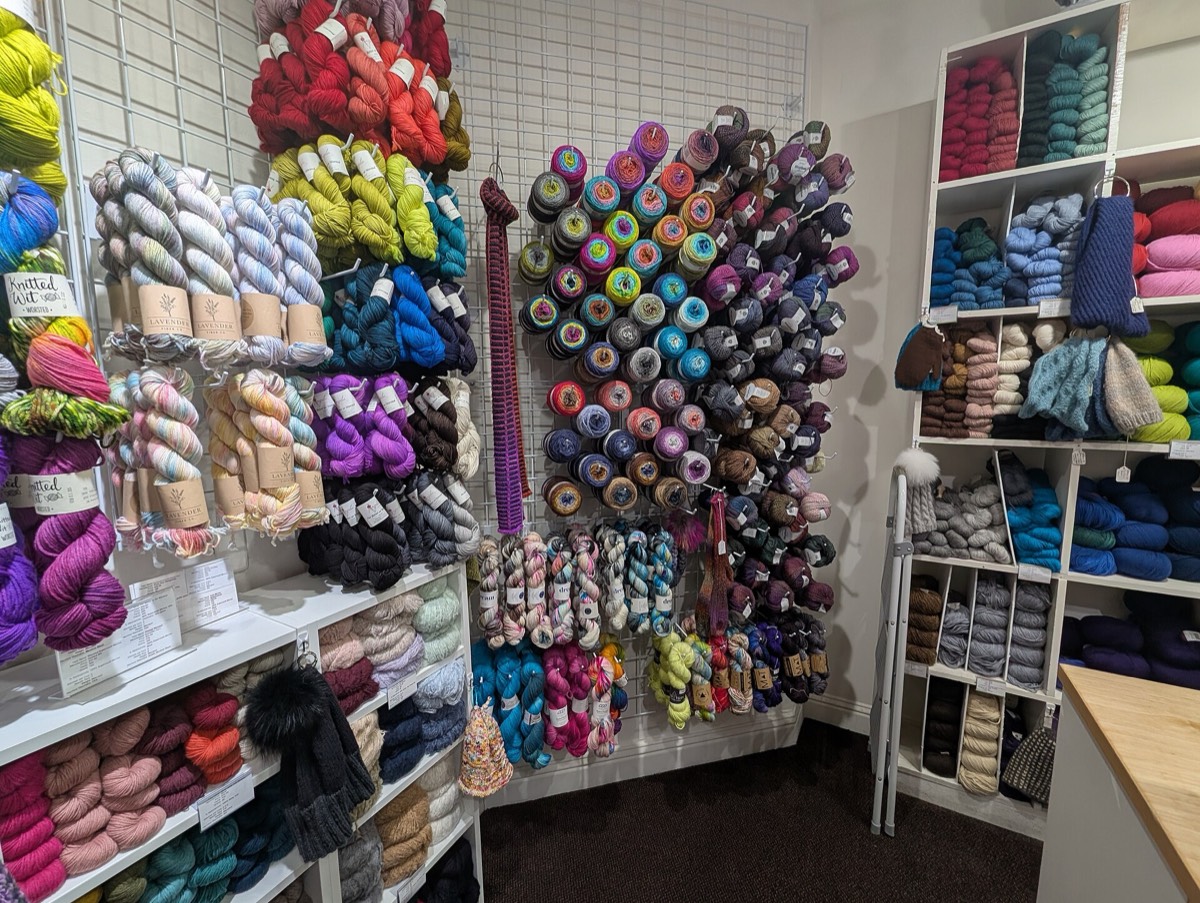

A yarn substitution fails in two ways: you run out, or the fabric is wrong. The first is arithmetic. The second is a set of judgement calls that yardage alone cannot make.
Start with length, not weight
Two 100 g skeins can hold very different amounts of yarn. A dense woollen-spun yarn might give 160 m per 100 g; a fluffy blown yarn might give 300 m. Substituting by weight therefore tells you almost nothing about whether you have enough.
Add up the total metres the pattern calls for, add a buffer, and divide by the replacement skein length. The substitution calculator does this and returns the number of skeins to buy.
Then check the gauge band
Stay within one CYC weight category where you can. A DK substituted for worsted will knit to a different fabric at the same needle size, and the pattern's stitch counts will no longer produce the intended measurements.
If you must cross a weight boundary, treat it as a new project: swatch to the pattern gauge, expect the row gauge to shift, and recalculate the garment length as well as the width.
Then check the fibre
| If the original is | Watch for |
|---|---|
| Wool | Memory and bloom; a cotton replacement will hang differently and feel heavier. |
| Cotton | Little elasticity and significant weight; a wool replacement will spring back and may knit up narrower. |
| Alpaca | Drape and growth; a wool replacement will hold shape more firmly but feel less soft. |
| Acrylic | Durability and easy care; a natural-fibre replacement will breathe differently and may pill less. |
| Silk or viscose | Drape and shine; substitutes often change how the finished edge behaves. |
Then check the structure
Ply, spin and texture affect stitch definition as much as fibre does. A smooth three-ply will not mimic a haloed mohair, and a chainette will not behave like a single-ply roving. If the pattern depends on crisp cables or defined lace, match the structure before you match the colour.
Swatch the substitute
Knit a swatch in the replacement yarn, wash it, and measure gauge. Compare it with the pattern's gauge and with the fabric you actually want. A yarn can be the right weight and still be the wrong fabric — too dense, too drapey, too fuzzy.
This is also the moment to check for bleeding dye and for how the yarn behaves at the cast-on edge. Some yarns look fine in the skein and split badly on the needles.
Buy the buffer, and buy it in one dye lot
Buy at least 10% more than the calculation suggests. Fifteen percent is safer for complex stitch patterns or a new-to-you fibre. Buy all the skeins at once: a late extra skein in a different dye lot is the most common way a finished project gets a visible stripe.
A worked example
A pattern calls for five skeins at 183 m each: 915 m. With a 10% buffer, you need 1,007 m. The replacement offers 200 m per skein, so 1,007 ÷ 200 = 5.04 — buy 6 skeins. The sixth skein is not waste; it is the difference between finishing the second sleeve and hunting for a discontinued lot online.
What not to do
- Do not substitute by skein count alone. Skein sizes are not standard.
- Do not assume the same weight label means the same gauge. Categories are ranges.
- Do not skip the swatch because the yardage worked out. Quantity and fabric are separate problems.
Once the substitute is chosen, recalculate the cast-on if your gauge changed. The cast-on calculator takes the new gauge and the finished width and returns the stitch count.
Limits
Matching weight and yardage gets you to the cast-on, not to the finished fabric. Fibre, spin, ply and needle size all change the hand, the drape and the way the garment wears. A substitute can be mathematically correct and still feel wrong. Swatch, wash, and compare the fabric with a garment you already like before buying every skein.