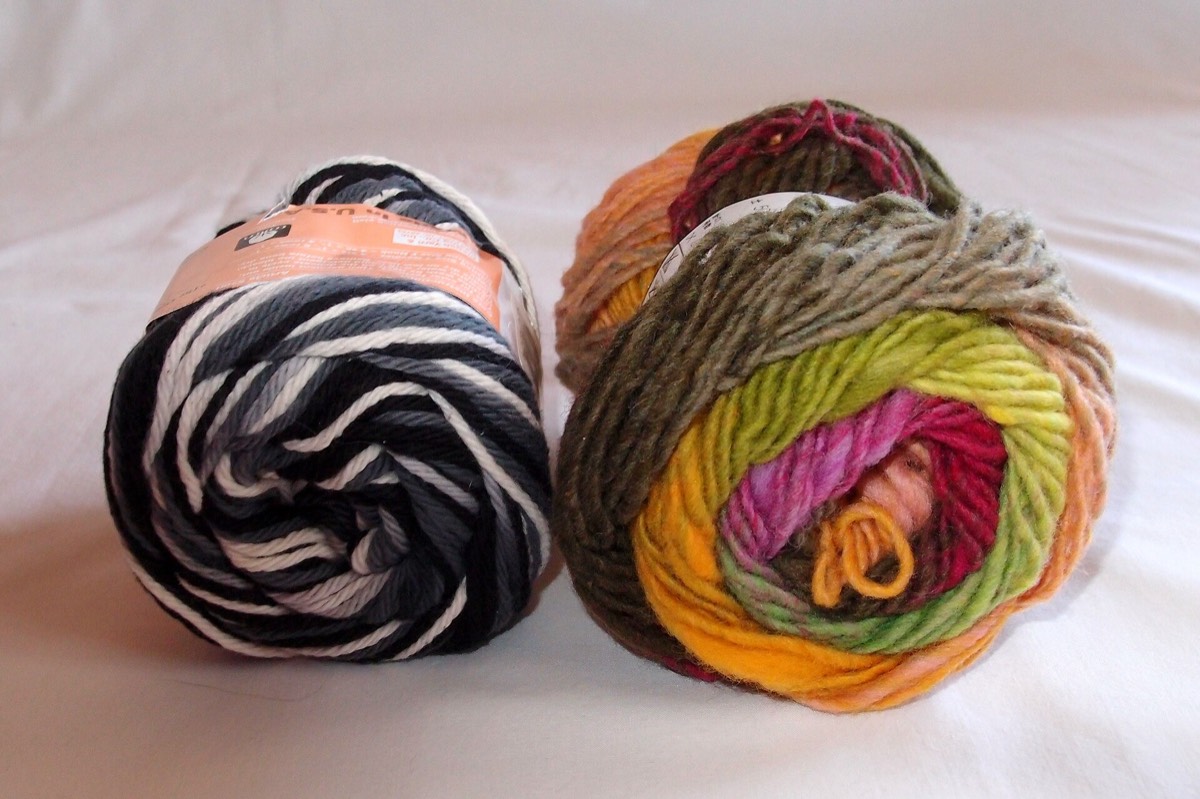

Wool and cotton can sit in the same weight category and still make completely different fabric. If you substitute by matching the label alone, you can end up with a garment that is the right size on the needles and the wrong weight on the body.
The short version: match the length and the gauge band, then expect the fabric to change. Cotton is heavier per metre, has little memory, and does not bloom after washing. It is a good swap for drape and warm-weather projects; it is a poor swap for fitted, elastic or winter garments.
What changes
| Property | Wool | Cotton | What it means |
|---|---|---|---|
| Warmth | Insulating, warm even when damp | Cooler and heavier | Not a winter swap |
| Elasticity | Good memory and recovery | Little memory | Ribbing and cuffs may sag |
| Weight | Lighter per metre | Heavier per metre | Buy by metres, not grams |
| Bloom | Fibres bloom after washing | Little bloom | Stitches may look looser |
| Drape | Holds shape | Drapes and grows | Changes the silhouette |
| Care | Often hand wash | Often machine wash | Test shrinkage first |
Gauge
Cotton does not bloom in the same way as wool. A wool yarn can fill the gaps between stitches after washing; cotton tends to stay where it was knitted. The same stitch count can therefore look more open in cotton, and the fabric can feel thinner at the same gauge.
Swatch the cotton in the pattern you will use, wash it, and measure. If the gauge is close but the fabric feels loose, go down a needle size and re-swatch. Do not assume the wool needle is the cotton needle.
Weight and drape
Cotton is generally heavier per metre than wool. A sweater knitted in cotton weighs more on the body, and that weight pulls the fabric down. Long garments, deep necklines and loose gauge grow more. If the design depends on a crisp, held shape, cotton may not be the right substitute.
The practical consequence is quantity. Buy by metres, not by the number of skeins. A 100 g skein of cotton may contain less length than a 100 g skein of wool; matching the weight can leave you several metres short.
Elasticity
Wool has memory: it stretches and recovers. Cotton has very little. Ribbed cuffs, neckbands and waistbands can relax and stay relaxed. If the garment relies on negative ease or a firm rib, a cotton substitution may need a narrower rib, a blended yarn, or a different construction.
Blends are often the better answer. A cotton–wool or cotton–acrylic blend keeps some of the cotton's drape and washability while restoring a little memory.
Warmth and breathability
Cotton is not a drop-in winter substitute. It is cooler, heavier and slower to dry. For summer tops, baby garments and drapey cardigans it can be excellent. For a winter sweater, a hat or socks, the swap changes the job the garment does.
Care
Cotton is often machine washable, but “machine washable” is not the same as “will not change”. Cotton can shrink in a hot wash and grow when hung wet. Wash the swatch the way you intend to wash the garment, dry it flat, and measure again. If the swatch grows by more than a stitch per 10 cm, recalculate the size.
A worked example
A pattern calls for 800 m of a wool aran at 100 m per 50 g skein. That is eight skeins, or 400 g.
The cotton substitute offers 85 m per 50 g skein. Matching the weight would mean buying 400 g, or eight skeins — but eight cotton skeins contain only 680 m. The project is 120 m short.
Matching the length means 800 ÷ 85 = 9.41, rounded up to 10 skeins. That is 500 g of cotton. The garment weighs more, but it has enough yarn.
When not to swap
- Fitted or negative-ease garments. Cotton's lack of memory makes the fit less forgiving.
- Deep ribbing and cuffs. They may relax and stay relaxed.
- Winter warmth. Cotton is cooler and heavier.
- Socks and items that need recovery. Use a wool or a wool-blend sock yarn.
- Projects where the yarn's bloom is part of the fabric. Cotton will look more open and flatter.
Limits
“Cotton” covers a wide range: combed, carded, mercerised, pima, organic, and blends with wool, acrylic or linen. Each behaves differently. Read the label, swatch the actual yarn, and treat this guide as a set of expectations rather than a guarantee.
Check the fibre behaviour first, then run the numbers through the substitution calculator.