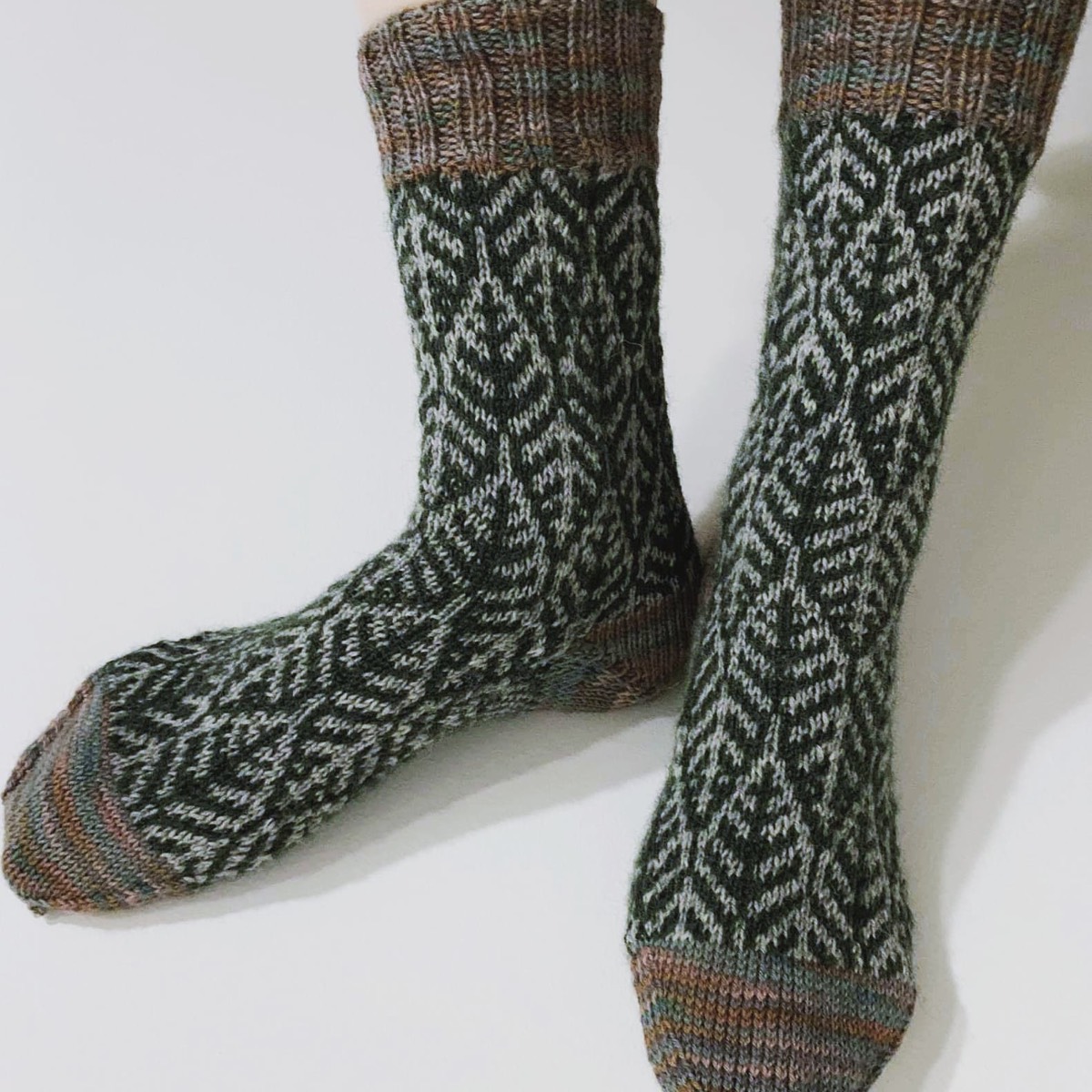

Intarsia is the technique for large blocks of colour: a motif, a picture, a wide stripe that does not run across the whole piece. Each colour gets its own length of yarn, and the yarns are joined at the boundaries rather than carried across the back. There are no long floats, but there are many ends and a real risk of holes at the joins.
The maths is mostly counting: stitches per block, rows per block, and yarn per block.
Plan the blocks
- Chart the design on a grid that matches your stitch and row gauge.
- Count the stitches in each colour block on each row. A block can change width from row to row.
- Decide where each new yarn length joins. A new bobbin or butterfly for every block is normal.
- Check that no block is so narrow that the join is impossible; a one-stitch colour change is fiddly.
Estimate yarn per block
Use the swatch-weight method on each block:
- Work out the block's area in square centimetres: stitches × rows × the area of one stitch-row.
- Divide the swatch weight by its area to get grams per square centimetre.
- Multiply the block area by that figure.
- Add a 15% buffer for joins, tails and matching the motif.
A worked example
A panel is 100 stitches wide and 60 rows tall. It has three blocks: 30, 40 and 30 stitches wide.
At 20 stitches per 10 cm and 24 rows per 10 cm, one stitch is 0.5 cm wide and one row is about 0.417 cm tall. One stitch-row is about 0.208 cm².
- 30 × 60 = 1,800 stitch-rows = 375 cm².
- 40 × 60 = 2,400 stitch-rows = 500 cm².
- 30 × 60 = 375 cm².
A 15 × 15 cm swatch weighs 10 g, so the density is 10 ÷ 225 = 0.0444 g per cm². The blocks need about 16.7 g, 22.2 g and 16.7 g — roughly 56 g total. Add 15% for joins and tails: about 64 g.
Joining without holes
At each colour change, bring the new yarn up from below and twist it around the old yarn before working the first stitch. The twist closes the gap. On the return row, twist the yarns again in the same direction; consistency matters more than the exact method.
Leave the tails long enough to weave in later. Do not pull the join tight; a tight join puckers the fabric. If a hole appears, it is usually because the yarns were not crossed at the boundary or the first stitch was worked too loosely.
Managing the yarns
Many small bobbins or butterflies keep the colours from tangling. Work with one block at a time and turn the work carefully; intarsia is slower than stranded knitting because the yarns must be kept separate. If the design has many colours, consider whether stranded colourwork or duplicate stitch would be simpler.
Intarsia or stranded?
- Intarsia for large blocks, a single motif, or a design with wide areas of one colour.
- Stranded colourwork for repeating bands and small motifs that travel across the row.
- Duplicate stitch for a small motif on a finished plain fabric.
Mixing the techniques is possible, but plan the joins so the floats and the bobbins do not interfere.
Limits
Intarsia does not have the stretch of a plain fabric at the joins; a very fitted garment may show the boundaries. The yarn quantity per block is an estimate, and the tails consume more than you expect. Swatch the joins before committing to a large panel.
Check the colourwork gauge and plan the joins before starting the motif.