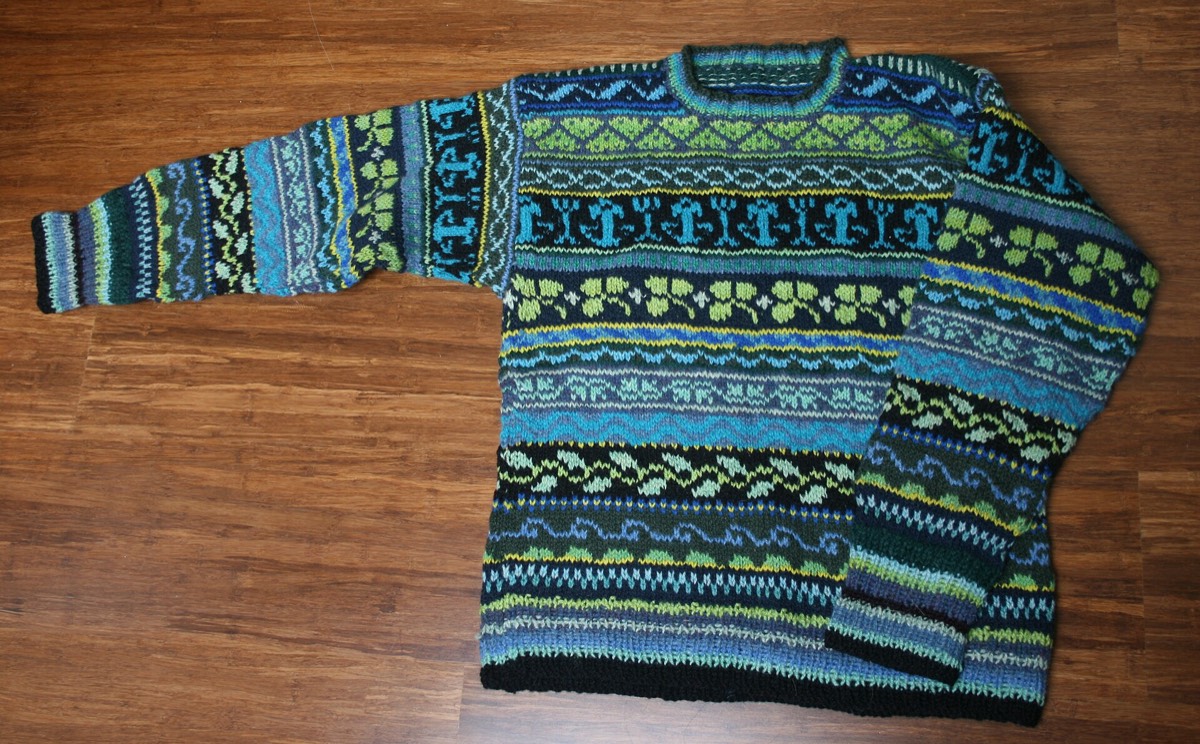

A stockinette swatch is not a colourwork swatch. Stranding a second colour adds floats across the back of the fabric, and those floats change the way the fabric behaves: it pulls in, it becomes denser, and the row height can change. If you use the stockinette gauge for a colourwork yoke, the fit will be wrong.
The fix is to swatch the colourwork itself, in the round, in the yarn and needle you will use.
Why colourwork changes gauge
- Floats. The unused colour travels across the back. If the floats are tight, the fabric pulls in; if they are loose, the stitches can spread.
- Fabric density. Two layers of yarn in the float areas make the fabric thicker and less stretchy.
- Needle size. Many knitters go up a needle size for colourwork to compensate for the tightening effect.
- Colour dominance. The pattern can look different depending on which colour sits on top; the fabric structure is the same, but the visual gauge changes.
How to swatch colourwork
- Use the actual colours and the actual motif, not a plain two-colour stripe.
- Work in the round if the project is in the round. A flat colourwork swatch includes purl rows and can give a different result.
- Make the swatch at least 15 cm around and 15 cm tall.
- Check the floats on the wrong side: they should lie flat without puckering the fabric.
- Wash and dry the swatch, then measure the middle.
A worked example
Your stockinette gauge is 20 stitches per 10 cm. The colourwork swatch gives 22. You want a 100 cm body.
At 20 stitches per 10 cm: 200 stitches. At 22: 220 stitches. The colourwork is 10% denser, so the same stitch count would make a body about 91 cm around — roughly a size smaller.
Options: go up a needle size and re-swatch; keep the needle and recalculate the stitch count; or accept the denser fabric and adjust the size. Do not use the stockinette count and hope the colourwork relaxes.
Float tension
Aim for floats that are long enough not to pucker the fabric but short enough not to catch on jewellery or fingers. Spread the stitches on the right needle as you work; this keeps the floats relaxed. If the fabric pulls in, the floats are too tight, not the stitch count.
Colour dominance is a separate issue: the colour that travels along the bottom of the float tends to sit forward. Be consistent across the project, or the motif can look uneven.
Row gauge
Colourwork often changes row height as well as width. A yoke or a colourwork band written in rows may land at a different depth. Check the row gauge on the swatch and convert the pattern's row counts if the difference is significant.
When it matters most
It matters on fitted garments, yokes and sleeves, where a 5–10% width change is visible. It matters less on a loose cowl or a blanket, where the fabric can tolerate a denser gauge. Even then, the float tension should be checked so the fabric does not pucker.
Swatch the motif, not just the colours
A two-colour swatch in plain stripes can behave differently from a motif with long floats. If the project has a large pattern repeat, swatch a representative band with the longest floats. The fabric density and the pulling-in effect are driven by the floats, not by the number of colours alone.
Limits
Colourwork gauge is pattern-specific. A swatch in a different motif can give a different result, especially if the floats are longer or the colour repeat is wider. Swatch the motif you will actually knit, or at least a representative band.
Swatch the motif in the round and measure both stitch and row gauge; the gauge guide covers the base distance.