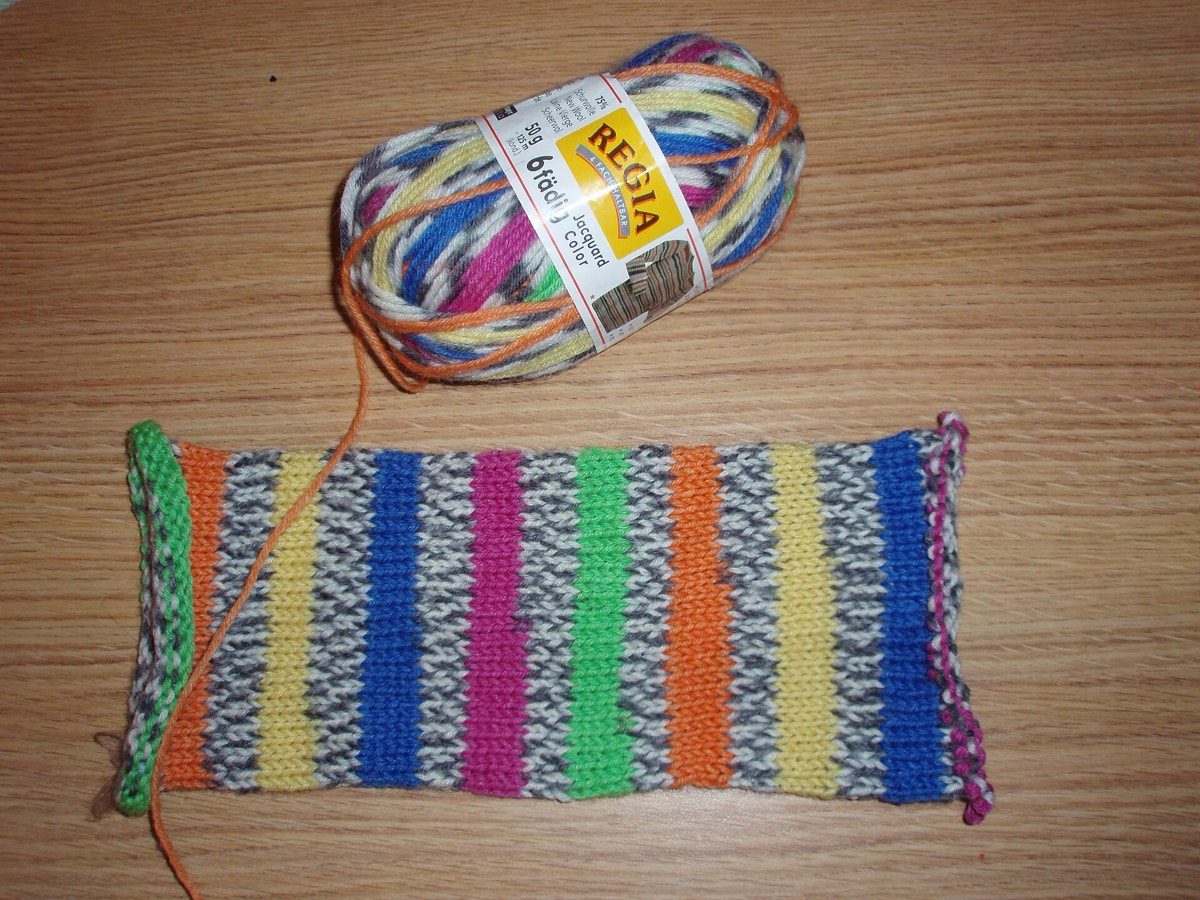

Self-striping and variegated yarns carry their colour in the skein, not in the pattern. The knitter chooses the stitch count, the stitch pattern and the project width; those choices decide how the colours land.
Two terms are often used loosely. Variegated means the colour changes across the skein, sometimes in short speckles, sometimes in long tonal runs. Self-striping means the colour changes are long enough to form stripes when worked at a typical gauge.
Types and effects
| Type | What you see | Works well in |
|---|---|---|
| Tonal | One hue, light to dark | Lace, cables, simple garments |
| Speckled | Short dots of colour | Stockinette, socks, accessories |
| Multi variegated | Several hues in short runs | Plain stockinette, small projects |
| Self-striping | Long repeats, clear stripes | Socks, hats, mittens |
Pooling and flashing
When the colour runs line up across rows, they can pool into patches or spiral down the fabric. This is not a defect; it is the interaction between the skein’s repeat length and the number of stitches in a round.
A wider project uses more yarn per row, so the colour repeats arrive sooner. A sock and a shawl made from the same skein can look unrelated. If you dislike pooling, change the stitch count, the stitch pattern, or the starting point of the skein.
Choosing a stitch pattern
- Stockinette: shows the colours most clearly; good for speckles and stripes.
- Garter: breaks up the colour runs and softens pooling.
- Ribbing: compresses the fabric; colours can look darker and denser.
- Lace: the holes and decreases interrupt the colour; use a tonal or subtle variegated yarn.
- Cables: the texture competes with busy colour; choose a tonal yarn.
A worked example
A 64-stitch sock in a self-striping yarn produces narrow stripes. The same yarn in a 120-stitch shawl produces wide bands, because each row uses almost twice as much yarn.
Knit a small swatch in the round at the project’s stitch count before committing. The swatch shows the real stripe width, not the width you imagined from the skein.
Alternating skeins
Hand-dyed skeins can differ slightly, even in the same dye lot. For a large project, alternate two skeins every two rows to blend the variation. This is especially important in stockinette, where any shift shows as a line.
Wind both skeins into cakes first, and keep the alternating pattern consistent at the edges.
Yardage and matching
Self-striping yarns are often sold in matching pairs for socks, but the repeats may not align at the same point. If you want identical socks, start each sock at the same colour in the repeat and check the length of the colour run against the foot length. If the repeat is shorter than the foot, the stripes will not match exactly.
For a larger project, buy all the yarn at once. A later skein may be from a different dye lot, and the colour shift will show at the join.
Blocking changes the fabric
Variegated colours can look sharper after blocking, especially in wool, because the stitches open and the colours separate. A swatch that looks muddy before blocking may read clearly after. Always judge the blocked swatch, not the raw knitting.
A note on speckles
Speckles are short, isolated spots of colour. They behave differently from long variegated runs: they do not pool into stripes, but they can form clusters if the same spot lands in the same place on consecutive rows. A plain stockinette fabric shows them best; ribbing and cables scatter them into noise.
Limits
You cannot fully control pooling, and you cannot make a busy variegated yarn read as a solid. Match the yarn to the project: simple stitches for busy colour, complex stitches for quiet colour. Swatch at the real stitch count, and accept that the second skein may behave differently from the first.