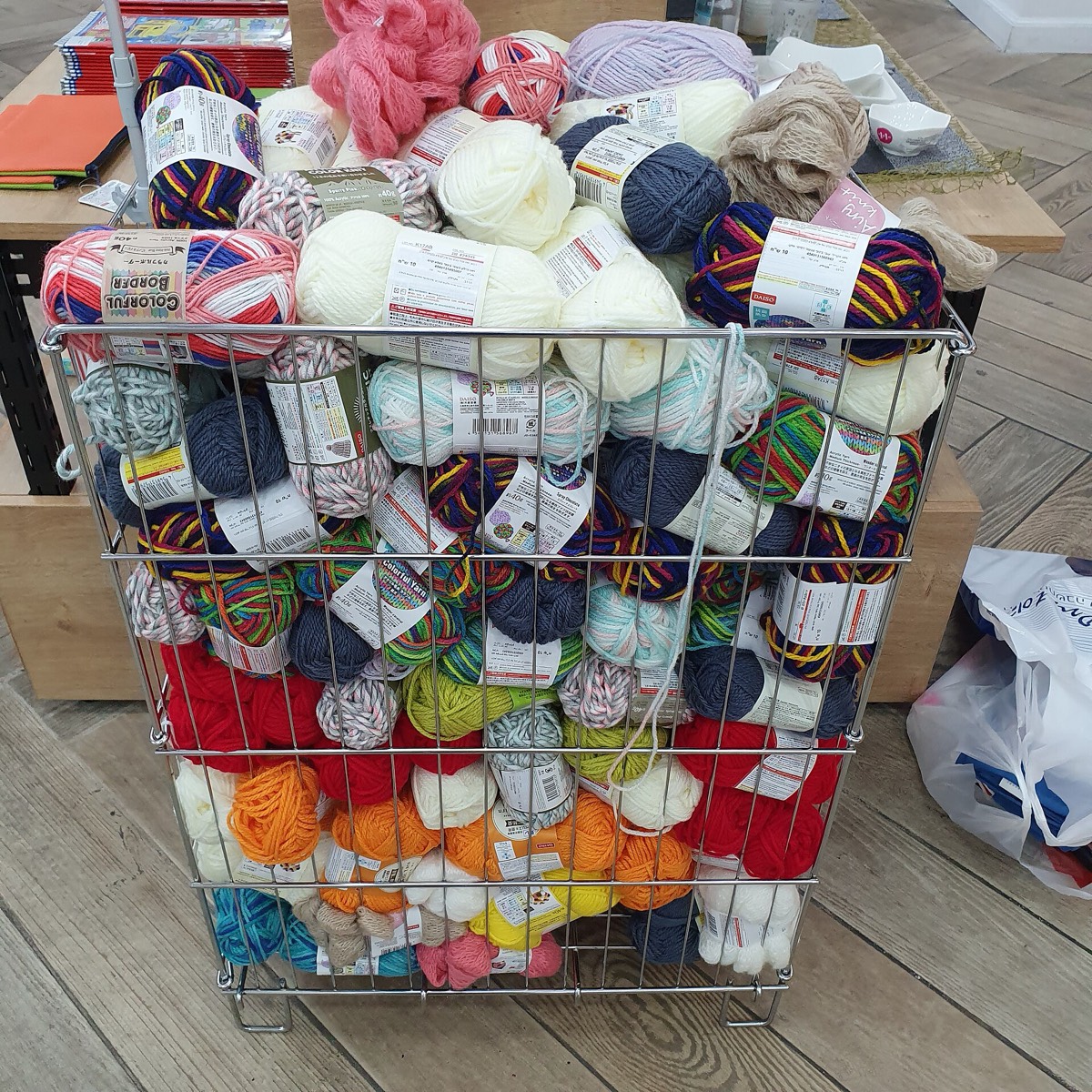

A yarn label is a specification sheet wrapped around the skein. It tells you what the yarn is, how much is in the skein, what gauge the manufacturer suggests, and how to wash the finished object. Most of the numbers are useful; some are marketing.
Read the label before you substitute, before you buy a project quantity, and before you wash the finished piece.
What the label contains
| Field | What it tells you | What to check |
|---|---|---|
| Brand and line | The product identity | Exact line name; lines change |
| Colour and dye lot | The colourway and batch | Buy all skeins in one dye lot |
| Weight category | CYC category 0–7 | It is a range, not a gauge guarantee |
| Fibre | Composition and percentages | Percentages should add to 100 |
| Put-up | Grams and length per skein | Length per 100 g is the comparison number |
| Gauge | Suggested stitches/rows over 10 cm | A starting point; swatch your own |
| Needles / hook | Suggested tool size | Metric size is the reliable number |
| Care | Wash, dry, iron symbols | Follow the most delicate instruction |
Length per 100 g
To compare yarns, divide the skein length by the skein weight and multiply by 100. A 100 g skein with 200 m is 200 m per 100 g. A 50 g skein with 90 m is 180 m per 100 g. The second yarn is denser: the same weight holds less length.
This is the number to use when substituting, not the number of skeins or the weight category alone.
Gauge and needle size
The label's gauge is a suggestion for a general fabric, usually in stockinette or single crochet. It is not the gauge for your pattern, and it is not a guarantee for your hands. Use it as a starting point, then swatch.
The suggested needle or hook is also a starting point. If the label says 4 mm and your pattern needs 5 mm to reach its gauge, the pattern wins.
A worked example
Label: 100 g, 200 m, 100% acrylic, 20 stitches and 26 rows per 10 cm on 4 mm needles.
A project needs 800 m. 800 ÷ 200 = 4 skeins, or 400 g. If you substitute a yarn with 180 m per 100 g, you need 800 ÷ 180 = 4.44, rounded up to 5 skeins, or 500 g.
The label's gauge says 20 stitches per 10 cm; your swatch gives 22. The label is a starting point, but your swatch is the number to use for the project.
Dye lots
The dye lot is the batch in which the yarn was dyed. Two skeins from different lots can differ subtly, and the difference often shows as a stripe in the finished fabric. Buy all the skeins for one project at once and keep the labels until the project is finished.
Care symbols
The care symbols are a compact washing and drying instruction. If a garment is made from more than one yarn, follow the most delicate care instruction. When in doubt, hand wash cool and dry flat.
Common mistakes
- Comparing yarns by skein count instead of length.
- Assuming the label's gauge is the pattern's gauge.
- Ignoring the dye lot.
- Treating the weight category as a guarantee of gauge.
- Washing according to the fibre rather than the label.
Limits
Labels vary by country and manufacturer. Some use symbols without words; some put the full specification on a QR code. If the label is missing, treat the yarn as unknown and swatch before planning a project.
For the next step, use the substitution method and check the gauge tolerance before buying.