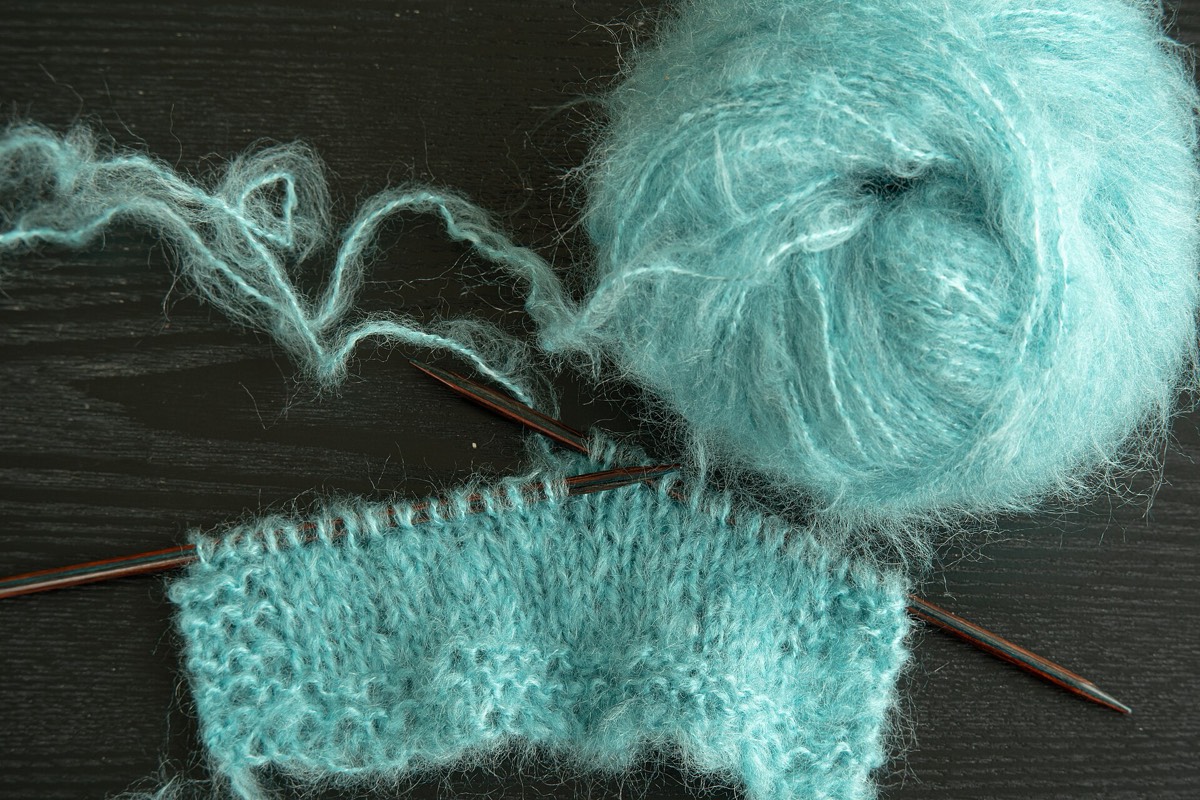

Alpaca, mohair and angora are sold as softness, and they deliver it. The same fibres also change the fabric in ways a weight label cannot show: they add drape, blur stitch definition and trap air. Substituting one for a smooth wool is not a like-for-like swap, even when the metres match.
The short version: match the length and gauge band, then decide whether the project can tolerate more halo, more drape and less memory. Hats, shawls and loose cardigans are forgiving; fitted garments and crisp cables are not.
What halo does
Halo is the cloud of loose fibre ends that stands out from the yarn. It traps air, which makes the fabric warmer and softer, and it softens the edges of every stitch. A cable worked in a haloed yarn looks like a soft ridge; the same cable in a smooth worsted-spun wool looks like a drawn line.
Halo also fills the gaps between stitches. A lace pattern can look denser and less open; a colourwork pattern can lose contrast as the fibres blur the edges. This is a design decision, not a defect.
Fibre by fibre
| Fibre | Halo | Drape | Memory | Care |
|---|---|---|---|---|
| Alpaca | Soft, moderate | High | Low | Hand wash, dry flat |
| Mohair | High, long | High | Low | Gentle wash, dry flat |
| Angora | Very high | High | Low | Gentle wash, minimal handling |
| Yak | Moderate | Moderate | Some | Hand wash, dry flat |
| Wool | Low to moderate | Moderate | Good | Depends on treatment |
These are tendencies, not rules. A mohair blend with a nylon core can be stronger and less fragile than pure mohair; a smooth alpaca can have less halo than a brushed wool.
Gauge and weight
Halo can make a yarn knit at a different gauge from a smooth yarn of the same weight. The fibres fill the spaces between stitches, so the fabric can look denser and measure wider or narrower depending on how the yarn is spun. Swatch the actual yarn, in the actual stitch pattern, and wash it.
Halo fibres are also often sold in small put-ups. A 25 g skein of mohair/silk may hold 200 m, while a 50 g skein of alpaca may hold 200 m. Matching the weight would give you half the length. Match the metres.
A worked example
A shawl pattern calls for three skeins of mohair/silk at 210 m per 25 g: 630 m, or 75 g.
An alpaca substitute offers 200 m per 50 g. Matching the length means 630 ÷ 200 = 3.15, rounded up to 4 skeins — 800 m, or 200 g. The alpaca version is more than twice the weight of the mohair version.
That may be fine for a shawl, where drape and warmth matter, but the extra weight will pull the fabric down. Swatch both if you can, and hang the swatch for a day to see how it grows.
When not to substitute
- Cables and crisp texture. Halo blurs the lines you are paying the pattern to show.
- Fitted garments that need memory. Alpaca and mohair stretch and do not spring back like wool.
- Colourwork with fine detail. Halo can reduce contrast and soften edges.
- Items that will be handled hard. Mohair and angora can shed and pill.
- Projects where the yarn's weight matters. A heavier substitute can change the drape and fit.
Care
Most alpaca and mohair yarns are hand wash or gentle cycle, and they should be dried flat. Do not wring or hang a wet garment; the weight of the water can stretch it. Brush or shake gently rather than rubbing, especially with angora.
Limits
“Alpaca” and “mohair” are often blends. A small percentage of nylon can change durability; a silk blend changes drape and sheen. Read the label, swatch the actual yarn, and treat this guide as a set of expectations rather than a guarantee.
Match the halo and the gauge, then use the yarn library to find a comparable blend.