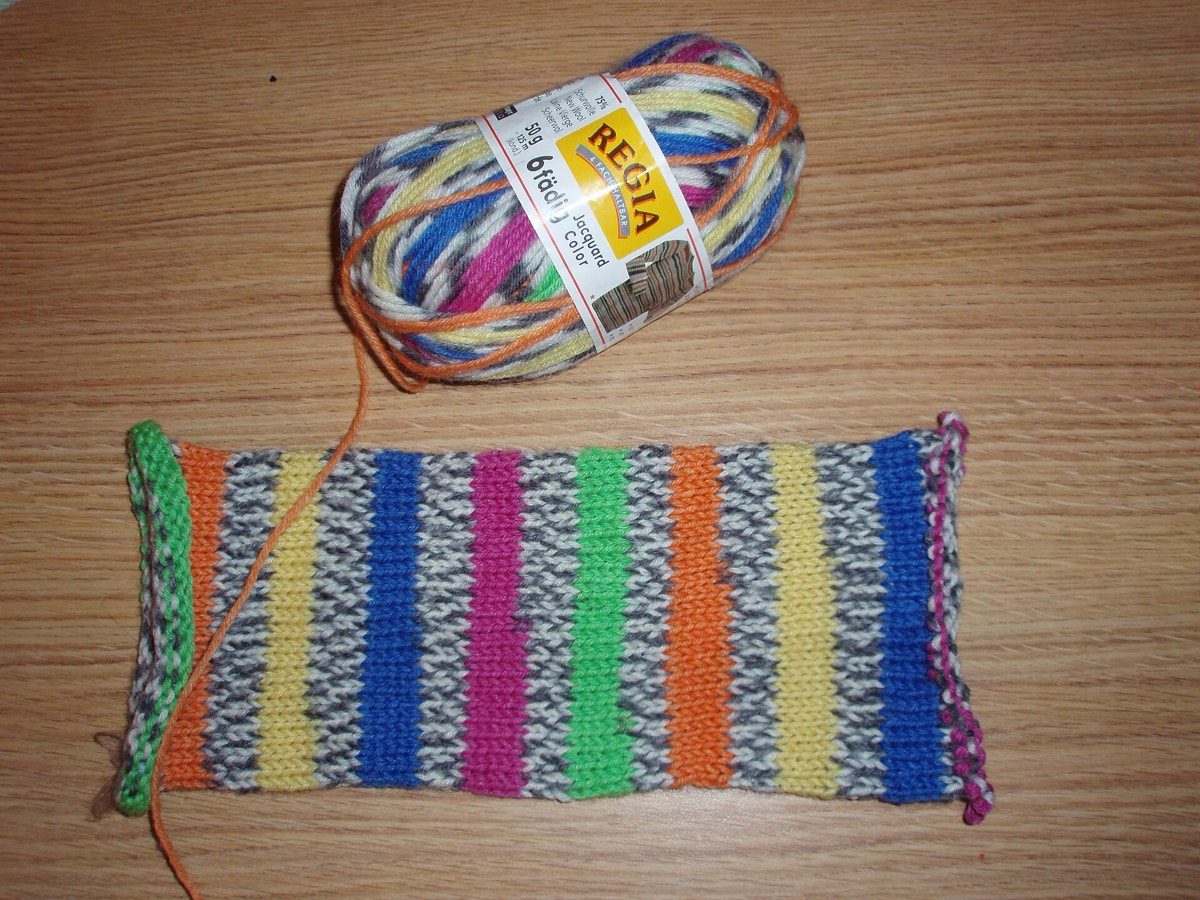

Variegated yarn does not behave like a solid colour. The dye repeats along the length of the yarn, and where those repeats land depends on the number of stitches in each row, the circumference and the gauge. Change the stitch count and the colours can shift from neat stripes to blotches — or from blotches to a deliberate pattern.
That behaviour is called pooling. It is not random; it is arithmetic.
Why pooling happens
- Colour repeat length. The distance between repeated colour sequences in the yarn.
- Stitches per row. The number of stitches in a round or row consumes a fixed length of yarn.
- Circumference. In the round, the row length decides where the colour sequence returns.
- Gauge. A tighter gauge uses less yarn per stitch, so the colour repeat covers more stitches.
- Stitch pattern. Texture and colourwork can break up or emphasise the pooling.
Test it in the round
Swatch with the actual stitch count and the actual circumference, not a flat square. Cast on the number of stitches you plan to use, join, and work several rounds. Watch where the colours land. A flat swatch can show the colour sequence but not the pooling that appears when the row closes into a circle.
If the fabric will be worked flat, swatch flat; the return rows change the colour placement.
A worked example
A sock yarn has a colour repeat that covers about 8 stitches at your gauge. At 64 stitches around, the repeat returns every 8 stitches; at 72, it returns at a different point. The two socks can look completely different even though the yarn is the same.
Changing the stitch count by 1–2 stitches can shift the pooling. That is useful if you want to break up an accidental blotch, but it also changes the fit. Do not change the sock circumference by several centimetres just to fix the colour; choose a different yarn or a stitch pattern instead.
Planned pooling
Some knitters plan pooling deliberately: choose a stitch count and gauge that make the colour repeat align into a regular pattern. It requires a yarn with a clear, consistent repeat and a swatch that behaves predictably. It is a design technique, not a guarantee; the same yarn can pool differently at a different gauge.
When pooling is a feature
Pooling can be beautiful in a scarf, a shawl or a simple sweater where the colour movement is the point. It can be distracting in a cable or lace pattern, where it competes with the texture. Decide which effect you want before choosing the stitch pattern.
When to avoid it
If you want even colour, choose a solid, a tonal, or a yarn with a very short repeat. A highly variegated yarn will always produce some variation; the only question is whether it looks intentional.
Choosing a stitch pattern
A textured stitch can break up pooling, and plain stockinette can make it more obvious. If you want the colour to be the focus, keep the stitch simple; if you want a more even fabric, choose a stitch pattern that interrupts the colour repeat. Swatch both before deciding.
The starting point
Where you begin in the colour sequence changes where the colours land in the first row. Before changing the stitch count, try starting the skein at a different point. It is a cheaper experiment than re-knitting a whole sock.
Limits
Dye lots vary, and two skeins of the same colourway can pool differently. The swatch is a guide, not a contract. If the first skein pools badly, try starting at a different point in the colour sequence before changing the whole plan.
Swatch at the real stitch count, and use the yarn library to compare put-ups and fibre blends.