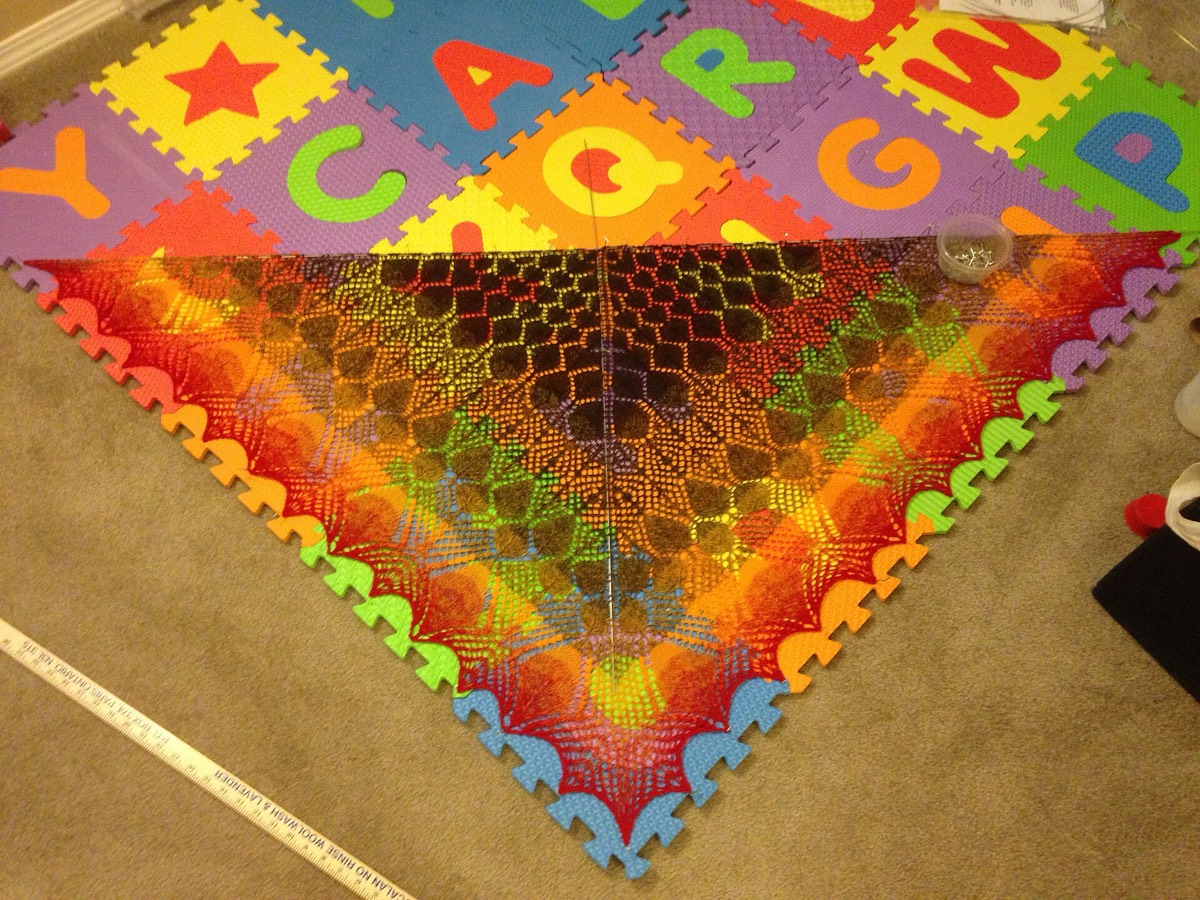

Lace is the one fabric where the unblocked swatch can be almost meaningless. The stitches are open, the fabric is limp, and the pattern is compressed until water and tension let it settle. Gauge for lace is measured after blocking, at the size you intend the finished piece to be.
That changes the order of operations: swatch, wash, pin, dry, then measure. If you measure before blocking, you are measuring a different fabric.
Why lace changes
- Yarn overs. The holes open when the fabric is stretched and set; before blocking they can close up.
- Fibre. Wool and alpaca relax and hold a block; cotton can be pinned but may spring back; silk has its own drape.
- Pattern. Different lace motifs open by different amounts; a swatch in a different motif can mislead.
- Tension. Lace is often knitted loosely; the blocked fabric can be much wider than the needles suggest.
How to swatch lace
- Cast on enough stitches for at least two full pattern repeats, plus edges.
- Work at least 15 cm, including several pattern repeats vertically.
- Wash the swatch the way you will wash the finished piece.
- Pin it to the measurements you intend for the finished fabric, using the pattern's gauge as a guide.
- Let it dry completely, then measure the middle.
Do not overstretch the swatch to make the numbers match. Pin it to the fabric you want, not to the number you hope for.
A worked example
The unblocked swatch gives 20 stitches per 10 cm. After blocking, it gives 18. You want a 100 cm body.
At the unblocked gauge: 200 stitches. At the blocked gauge: 180 stitches. The blocked fabric is wider, so the same stitch count produces a larger piece.
Use the blocked gauge for the cast-on. If the pattern's gauge is also blocked, compare like with like; if the pattern does not say, assume the gauge is after blocking for lace.
Blocking lace
Wet the piece, squeeze gently, roll it in a towel, and pin it out on mats. Use rustproof pins and place them at the points of the motif so the pattern opens evenly. Measure the width and length as you pin; the fabric should be under gentle tension, not stretched to its limit.
Let it dry completely before removing the pins. If you remove them while the fabric is still damp, the lace can relax back toward its unblocked size.
Row gauge and length
Lace can change row gauge as much as stitch gauge. A shawl that is pinned wider may also become shorter. Measure both directions after blocking, and check the finished dimensions against the schematic rather than only the stitch count.
When it matters most
It matters for shawls, lace garments and anything where the finished size is part of the design. It matters less for a small lace trim or a motif that will be seamed into a larger piece, where the surrounding fabric controls the shape.
If the blocked gauge is off
If the blocked swatch is wider than the pattern's gauge, go down a needle size and re-block. If it is narrower, go up. Do not compensate by pinning harder; the finished piece will relax back. A lace gauge that is far out usually means the needle or the yarn is wrong, not the blocking.
Limits
Blocking is not infinitely adjustable. A lace fabric can be opened to a point, but overstretching distorts the motif and can damage the fibre. If the blocked gauge is far from the pattern, change the needle or the yarn rather than forcing the block.
Block the swatch before measuring; the wool blocking method is the reference for the final size.