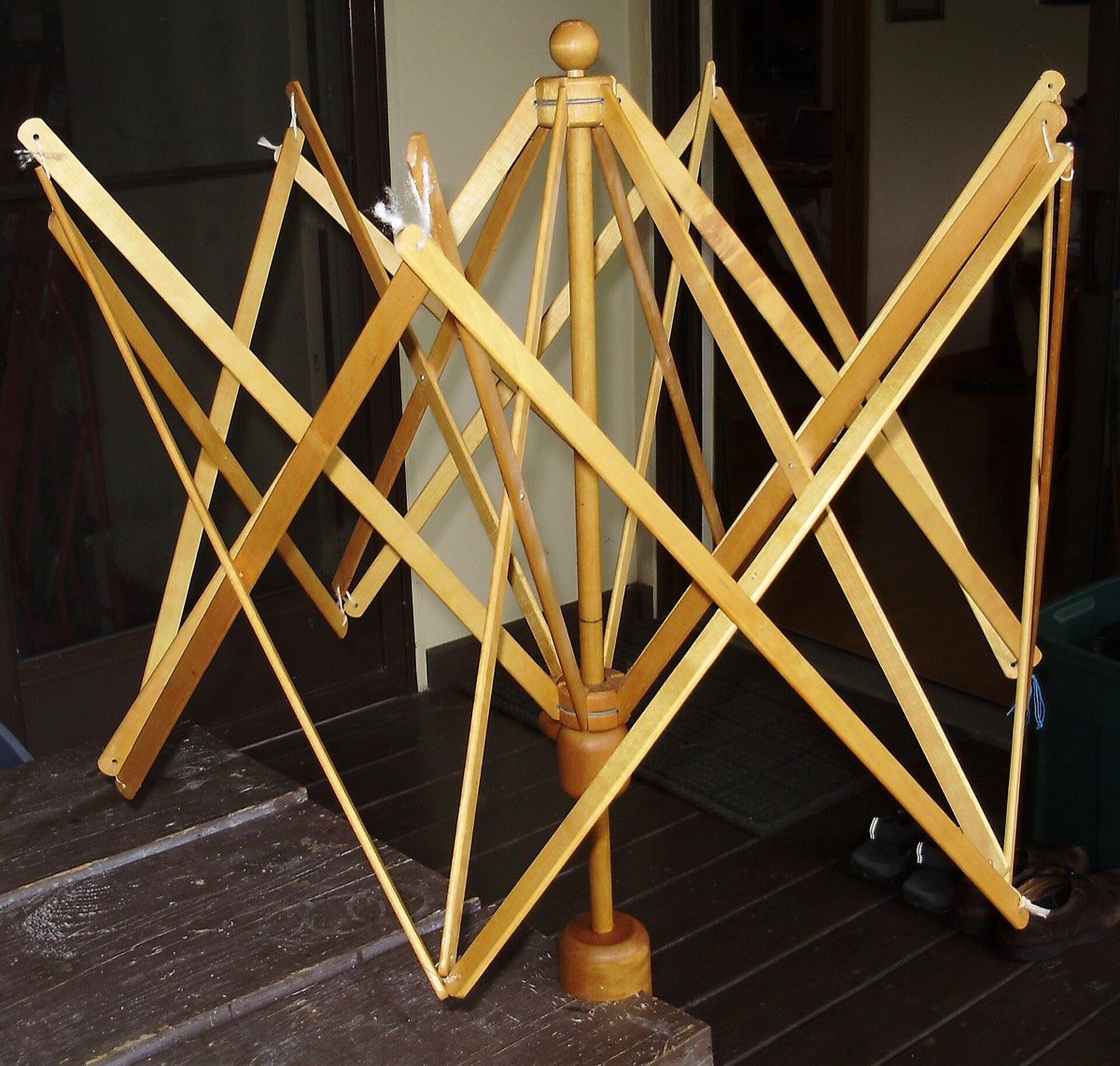

A swift and a winder are two different tools that are often sold together. The swift holds a skein open under light tension; the winder turns it into a cake. Neither is required for knitting, but together they make hand-dyed skeins much easier to handle.
What each tool does
| Tool | Job | Best for | Watch for |
|---|---|---|---|
| Umbrella swift | Holds a skein open | Hand-dyed skeins, lace yarns | Over-tension; collapsing arms |
| Amish swift | Holds a skein on pegs | Smaller skeins, workshops | Fixed circumference |
| Ball winder | Winds a cake | Most yarns | Winding too tightly |
| Nostepinne | Hand-winds a ball | Travel, small amounts | Slow; uneven tension |
How to use them together
- Open the skein and check for ties; keep the ties in place until the skein is on the swift.
- Place the skein over the swift and open the arms until the skein is held gently, not stretched.
- Find the outside end and lead it to the winder, keeping a light, even tension.
- Wind steadily; guide the yarn across the cake rather than letting it build in one spot.
- Slide the cake off and leave it to relax before knitting.
Cakes, balls and skeins
A skein is the looped form yarn is often sold in; it needs a swift to hold it while you wind. A ball is round and can be wound by hand. A cake is a flat, cylindrical package from a winder, usually with a centre pull. Cakes stack neatly and feed evenly, but they can collapse if wound loosely.
For colourwork, wind each colour into its own cake and keep them separate. For a large project, wind only what you need; a cake that sits for months can compress at the bottom.
A worked example
A 100 g hand-dyed skein is 400 m; check the label for yardage before you wind. Put it on the swift, wind it into a cake, and check that the cake is firm but not tight. A tight cake compresses the yarn and can make the first few metres feel different from the rest.
If you wind a partial skein, leave the remaining yarn on the swift or re-tie it loosely. A cake that has been wound under tension should relax for an hour before swatching.
Common mistakes
- Winding too fast: the yarn heats and stretches, especially wool.
- Over-tensioning the swift: the skein should be held, not pulled.
- Winding centre-pull from a cake: possible, but the cake can collapse; wind from the outside if unsure.
- Cutting the ties too early: the skein tangles before it reaches the swift.
- Using a winder on a skein with slubs or thick points: guide by hand and slow down.
When you can skip them
If you buy yarn in balls or cakes, you do not need a winder, but you may still want the substitution calculator when matching a new yarn. If you buy skeins occasionally, a friend with a swift or a yarn shop’s winding service is enough. A nostepinne or a pair of hands can wind a workable ball for a small project.
Tension and the winder
Let the winder pull the yarn; do not pull back. Your hand should guide the yarn across the cake, not tension it. If the yarn feels hot or squeaks, you are winding too fast or too tight. Slow down and let the cake build evenly.
Limits
A swift and winder change the form of the yarn, not its quality. A light hand is the whole skill. They will not fix a tangled skein, and a badly wound cake can still tangle. Wind slowly, keep the tension light, and let the cake rest before you knit from it.