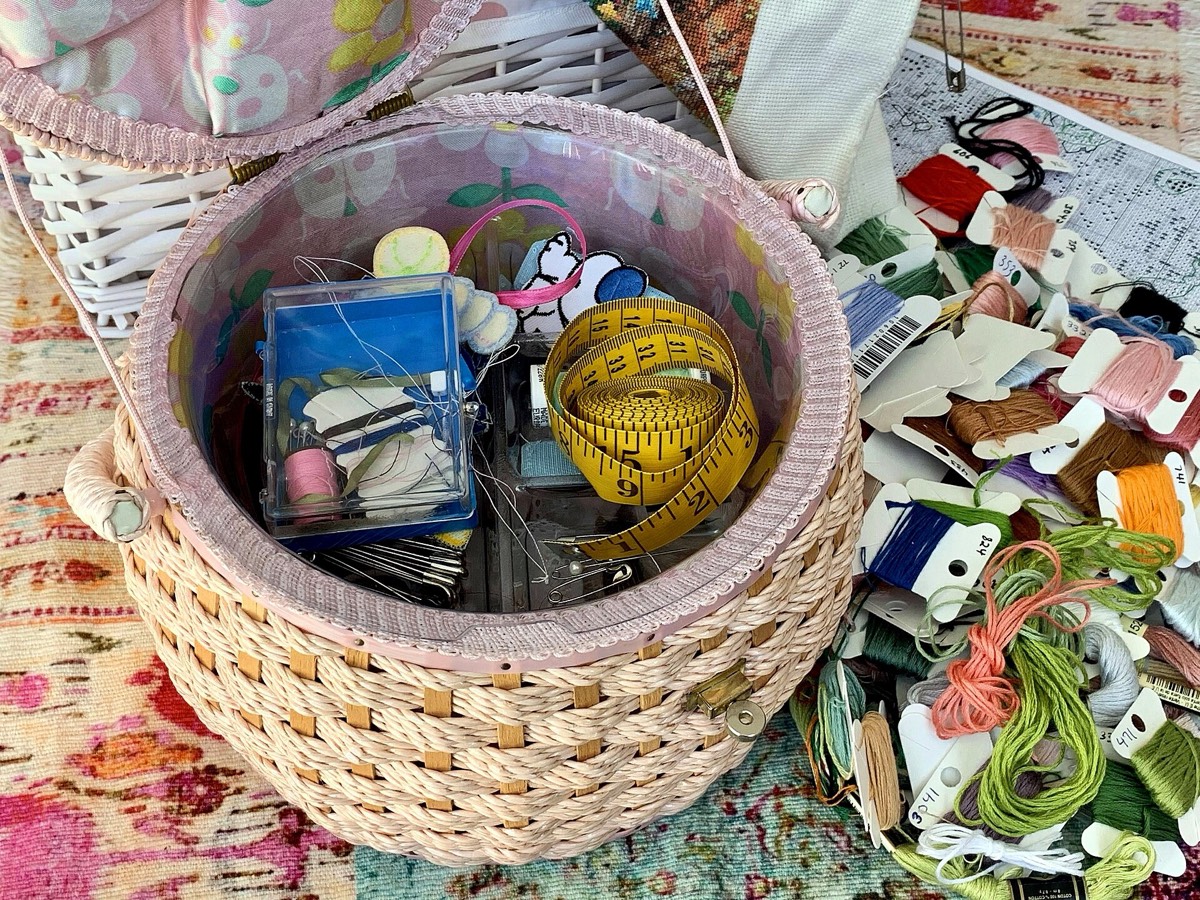

Knitting needs very little: yarn, needles and a pattern. Everything else is a convenience. A small kit that covers the common jobs is easier to carry, easier to find and easier to replace than a drawer of single-purpose gadgets.
The test for any tool is simple: does it solve a problem you actually had on the last project?
The core kit
| Tool | Why it earns its place | Can wait until |
|---|---|---|
| Needles in the project size | Nothing works without them | — |
| Tapestry needle | Seaming, weaving in ends | — |
| Small scissors | Cutting yarn cleanly | — |
| Tape measure | Gauge and length checks | — |
| Stitch markers | Rounds, repeats, shaping | — |
| Row counter | Shaping and repeats | Complex projects |
| Cable needle | Cables | A cable project |
| Blocking mats | Finishing | Lace or fitted garments |
What can wait
A needle gauge is useful when the size markings have worn off, but most needles are labelled. A yarn winder is useful for skeins, not balls. A second set of interchangeable tips is useful when two projects use the same size, not before.
Buy the tool when the project asks for it. A tool bought “just in case” usually stays in the bag.
A worked example
A hat in the round needs: one 40 cm circular needle in the project size, a set of double-pointed needles for the crown, a tapestry needle, scissors, a tape measure and four markers. That is the whole kit for the project.
If the pattern has a cable, add a cable needle. If it needs blocking, add mats and pins. If it has a folded brim, add a spare needle in the same size. Nothing else is required.
Keeping the kit usable
- Keep one small bag per active project, with only that project’s tools.
- Replace the tapestry needle when the eye snags; a worn eye damages yarn.
- Keep scissors sharp; blunt scissors chew the yarn end.
- Store markers by type so you can find four of the same colour.
- Put the tools back at the end of a session; a missing tape measure stops a project.
One bag per project
A small bag for each active project solves most tool problems. Put the yarn, the pattern, the needle, the markers and the tapestry needle in one place. When you pick up the bag, the project is ready; when you finish, the tools go back.
Label the bag with the project name and the needle size. A project that stalls for months is easier to resume when the bag tells you what it is.
What to leave at home
For travel, take the minimum: the project needle, a spare needle in the same size, a tapestry needle, a small pair of scissors and a few markers. Leave the blockers, the winder and the extra tips at home. A travel kit that fits in a pocket is more likely to be used than a full kit that stays behind.
A note on needles
The needle is the one place not to be minimal. A circular needle in the right cable length makes a hat, a sweater and a blanket possible; a straight needle limits you to flat pieces. Read how to choose a cable length before buying a set.
Limits
A minimalist kit is not a rule. If you knit lace, colourwork and garments, you will accumulate more tools, and that is fine. The point is to choose tools for real jobs, not to collect them. A small kit that you know how to use always beats a large one you have to search through.