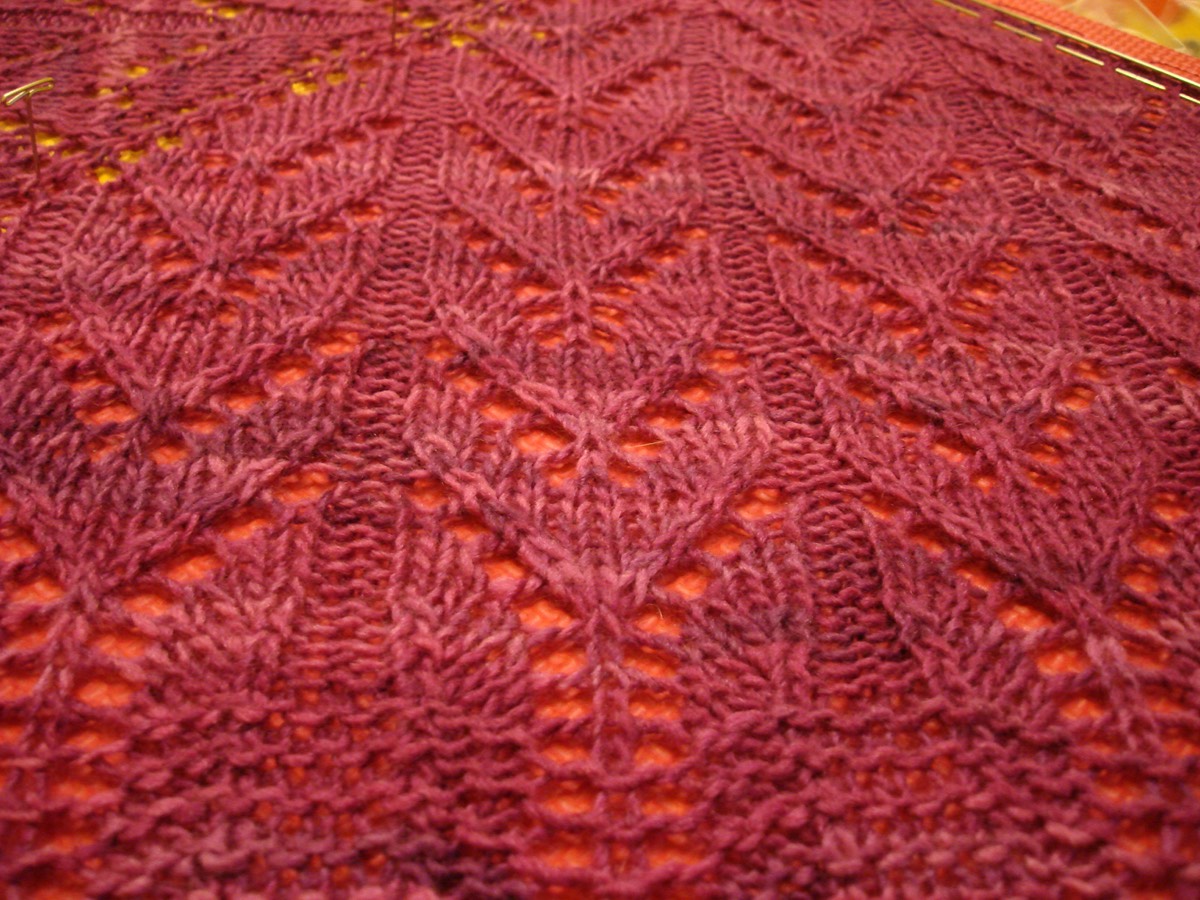

Blocking tools do three jobs: give the piece a flat surface, hold an edge straight, and open the fabric to its final measurements. Mats, wires and pins are not interchangeable; each solves a different part of the problem.
The goal is not to stretch the knitting as far as it will go. The goal is to hold it at the measurements you want, evenly.
What each tool does
| Tool | Job | Best for | Watch for |
|---|---|---|---|
| Interlocking mats | Flat, pinned surface | Lace, garments, granny squares | Grid lines can distort judgement |
| Blocking wires | Hold a straight edge | Shawls, scarves, blanket borders | Sharp ends; rust if wet |
| T-pins | Hold an edge or point | Lace points, corners | Can leave holes in fine fabric |
| Glass-head pins | General pinning | Most fibres | Plastic heads can melt with steam |
| Spray bottle | Dampen the fabric | Wool, cotton, linen | Over-wetting; slow drying |
Setting up
- Lay the mats on a flat surface and join them so the piece fits without hanging over an edge.
- Measure the finished dimensions from the pattern and mark them with pins or a tape measure.
- Dampen the piece according to the fibre; do not soak it unless the label allows it.
- Pin the corners first, then the midpoints of each edge, then the spaces between.
- Use wires for long straight edges; pin the wire, not every stitch.
- Leave the piece to dry completely before removing the pins.
Steam, spray or soak
The fibre decides the method. Wool and wool blends usually respond to spraying or light steaming (blocking wool); cotton and linen can take more water (blocking cotton and acrylic); acrylic and some synthetics can relax permanently with heat, so test first. Always check the yarn label and test a swatch.
When steaming, hold the iron a few centimetres above the fabric and let the steam penetrate. Never rest the iron on the knitting or the mat. When spraying, dampen evenly and avoid soaking the edges more than the centre.
A worked example
A triangular lace shawl is 180 cm across the top and 90 cm deep. Join enough mats to hold the full width. Thread a blocking wire along the top edge and pin the wire at both ends and the centre. Pin the two side edges at the points, then fill in between. Measure the depth from the top edge to the bottom point.
The wires keep the top edge straight; the pins open the lace. Without wires, the top edge can scallop; without pins, the points close up.
Care and mistakes
- Rust: dry wires and pins immediately after use; do not store them damp.
- Dents: do not pin through the same hole twice; move the pin slightly.
- Over-stretching: pin to the measured size, not to the limit of the fabric.
- Uneven edges: measure both sides, not just one.
- Steam on plastic: keep an iron a few centimetres away and never rest it on the mat.
Storing the tools
Dry mats fully before stacking them; trapped moisture can smell and distort the surface. Coil wires loosely and keep them in a tube or bag so they do not kink. Store pins in a closed container, and keep them away from yarn to avoid rust marks. A dedicated blocking box makes the setup faster next time.
Limits
Blocking cannot fix a garment that is the wrong size, and it cannot add length that the yarn does not have. It can only reveal the shape the knitting already has. It sets the shape the knitting already has. For heavily felted or delicate fibres, test a swatch first; some yarns are better steamed lightly than soaked.